
Showing posts with label DEPRESSION. Show all posts
Showing posts with label DEPRESSION. Show all posts
Saturday, June 29, 2013
Saturday, June 18, 2011
Last statement sent to Sentinel from New Hampshire self-immolation victim
Editor's Note: This past Wednesday, June 15th, a New Hampshire man set himself on fire in front of a courthouse.
Michael Moore
Sentinel Source
Editor's note: On Thursday morning, June 16, The Sentinel received a "last statement" via mail from a man who insinuated that he planned to set himself on fire in front of the Cheshire County Court House, and an explanation of why he intended to do so. Through further reporting, The Sentinel is confident this is from the victim of Wednesday afternoon's fire, although police have not yet received confirmation of his identity. The 15-page statement is printed in full, except for two redacted items: The names of the man's mother and his three children. Details will be posted as they become available.
Last Statement
by Tom Ball
A man walks up to the main door of the Keene N.H. County Courthouse, douses himself with gasoline and lights a match. And everyone wants to know why.
Apparently the old general was right. Death is not the worst of evil.
I am due in court the end of the month. The ex-wife lawyer wants me jailed for back child support. The amount ranges from $2,200. to $3,000. depending on who you ask. Not big money after being separated over ten years and unemployed for the last two. But I do owe it. If I show up for court without the money and the lawyer say jail, then the judge will have the bailiff take me into custody. There really are no surprises on how the system works once you know how it actually works. And it does not work anything like they taught you in high school history or civics class.
Read Full Article


 |
| Photo - Sentinel Source |
Sentinel Source
Editor's note: On Thursday morning, June 16, The Sentinel received a "last statement" via mail from a man who insinuated that he planned to set himself on fire in front of the Cheshire County Court House, and an explanation of why he intended to do so. Through further reporting, The Sentinel is confident this is from the victim of Wednesday afternoon's fire, although police have not yet received confirmation of his identity. The 15-page statement is printed in full, except for two redacted items: The names of the man's mother and his three children. Details will be posted as they become available.
Last Statement
by Tom Ball
A man walks up to the main door of the Keene N.H. County Courthouse, douses himself with gasoline and lights a match. And everyone wants to know why.
Apparently the old general was right. Death is not the worst of evil.
I am due in court the end of the month. The ex-wife lawyer wants me jailed for back child support. The amount ranges from $2,200. to $3,000. depending on who you ask. Not big money after being separated over ten years and unemployed for the last two. But I do owe it. If I show up for court without the money and the lawyer say jail, then the judge will have the bailiff take me into custody. There really are no surprises on how the system works once you know how it actually works. And it does not work anything like they taught you in high school history or civics class.
Read Full Article

Monday, October 25, 2010
Veteran Suicides Outnumber US Military Deaths in Iraq and Afghanistan: REPORT

Truthout
More than 1,000 veterans in California under 35 died after returning home from Iraq and Afghanistan between 2005 and 2008 - three times as many California service members who were killed in conflict overseas, according to a recently published Bay Citizenreport.
Investigative journalist Aaron Glantz studied the cases of Reuben Paul Santos, Alex Lowenstein and Elijah Warren to shed light on a growing trend among Afghanistan and Iraq veterans who have died through high-risk behavior and suicide after being discharged. In particular, veterans who returned home to California died through motorcycle and motor vehicle accidents and unintentional poisoning; in addition, veterans were two and a half times as likely to commit suicide as Californians of the same age who had not served in the military.
Glantz, who has reported on the Iraq and Afghanistan wars since 2005, decided to focus on veterans in California because "it's important to look at our own community. [Santos] was this young man that was from a community that was literally right down the street. That's how silent this epidemic is."
Read Full Article
Fresh food that lasts from eFoods Direct (Ad)
Live Superfoods
Print this page

Saturday, October 16, 2010
Majority in America View Gov't as Too Invasive and Powerful
Lydia Saad
Gallup
PRINCETON, NJ -- Record- or near-record-high percentages of Americans are critical of the size and scope of government, as measured by four Gallup trend questions updated in September. This sentiment stretches to 59% of Americans now believing the federal government has too much power, up eight percentage points from a year ago.

59% of Americans now believe the federal government has too much power.
46% believe "the federal government poses an immediate threat to the rights and freedoms of ordinary citizens". Only slightly more (51%) disagree with that statement *
SEE FULL Gallup report here
Fresh food that lasts from eFoods Direct (Ad)
Live Superfoods It is time to Wake Up! You too, can join the "Global Political Awakening"!
Print this page

Gallup
PRINCETON, NJ -- Record- or near-record-high percentages of Americans are critical of the size and scope of government, as measured by four Gallup trend questions updated in September. This sentiment stretches to 59% of Americans now believing the federal government has too much power, up eight percentage points from a year ago.

59% of Americans now believe the federal government has too much power.
46% believe "the federal government poses an immediate threat to the rights and freedoms of ordinary citizens". Only slightly more (51%) disagree with that statement *
SEE FULL Gallup report here
Fresh food that lasts from eFoods Direct (Ad)
Live Superfoods
Print this page
Monday, October 11, 2010
The Killing and Reviving the American Dream

Lew Rockwell
USA Today loves to run lifestyle features that purport to show how we are living, what we are doing, what we like and what we don't like – premised on a collectivist assumption that all our preferences can be tracked and characterized with these aggregate claims.
Most of the time, these features are silly. It's not really true that we are all listening to Lady Gaga and Justin Bieber, or tweeting what we had for breakfast.
However, the other day, the paper offered a roundup of how the great recession has affected American life. The business cycle is one of those forces that does indeed affect everyone, so perhaps it makes sense to examine what the paper had to say.
The trends are gleaned from US Census data, which provide a look at how economic downturns can devastate a society, and offer a glimpse into a theme that the Austrian tradition has long emphasized. Economics isn't just about trade statistics, retail sales or GDP. It is the very pith of life.
What the Census data indicate is that our mobility has been drastically curtailed from what it was a few years ago. The number of people who have not moved from one home to another, from one community to another, has risen substantially.
Read Full Article
Fresh food that lasts from eFoods Direct (Ad)
Live Superfoods
Print this page
Sunday, September 26, 2010
Wealth inequality rivals the months prior to the Great Depression
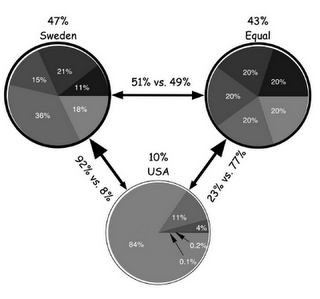
The official announcement that the recession is over underscores the massive disconnect between Wall Street and the rest of America. Wealth inequality in America is at levels last seen right before the Great Depression ravaged our economy. Yet the inequality has grown even more intense as this crisis has gone forward. 43 million Americans are now classified as being in poverty. This trend hasn’t shifted in the last decade, recession or no recession. The system is absolutely flawed and that is why we have over 16 percent underemployment, 41 million Americans on food stamps, 4 out of 10 workers in low paying service sector jobs, the median household income falling under $50,000, record monthly foreclosure filings, and yet the recession is over according to a small group of economists. The recession may be over for Wall Street but the rest of America is still struggling.
Wealth inequality has been exacerbated by the casino like behavior of investment banks on Wall Street. A recent study shows how out of touch with the facts most Americans are when it comes to wealth inequality in their own country. One fascinating finding is that most Americans, even between those that make $50,000 and $100,000 actually envision optimal wealth distributions that are very similar:
Read Full Article
Fresh food that lasts from eFoods Direct (Ad)
Live Superfoods
Print this page
Wednesday, September 22, 2010
Orwellian DoubleThink: Collapse is Recovery
 Orwellian DoubleThink Series, part 5
When the National Bureau of Economic Research announced, after much deliberation apparently, that the economic recession ended in June, 2009, it was as if the news were broadcast from some other planet. It is Orwellian DoubleThink at its finest, where a compartmentalized think-tank uses some off-world calculus to come up with a conclusion that flies right in the face of observable reality and real-world experience here on Earth.
Here are just a few of the key stories of the week for those who prefer real analysis to pure propaganda:
- Foreclosures Rise, Repossessions Set Record -- Rick Sharga, Vice President of RealtyTrac talks about a "managed slowdown" by banks, where "underlying conditions haven't improved." High unemployment and falling home prices do not mean a recovery is underway.
- Home Prices Drop in 36 States . . . Prices to Stagnate for a Decade -- Among other sources, CoreLogic methodology, which incorporates more than 30 years of transactions, representing 55 million observations from property information databases does not conclude that the outlook is anywhere close to recovery.
- Gerald Celente Says "U.S Economy = Depression" -- One of the world's leading trend forecasters goes beyond simple recession. In a recent interview with Russia Today, he was asked to respond with one word that defines the U.S. Economy -- that word was notrecovery.
- 20 Signs That The Economic Collapse Has Already Begun For One Out of Every Seven Americans -- Even though "most Americans haven't felt it yet" there are some undeniable signs of economic collapse. To believe otherwise, as the NBER suggests, is willful ignorance.
- Income Poverty: One in Three Americans Lacks the Income to "Make Ends Meet" -- This is the real-world measure that goes beyond all statistics. This study suggests that "young adults are among the hardest hit." In other words, the pillars for future success of the country are not finding that there are sufficient jobs, or that those jobs are paying wages that can support the basic cost of living. There is an increasing number of working poor and the outright destitute -- not people jumping for joy over real signs of a recovery.

Perhaps one of the articles that best summarized the results from the NBER came from renown economist David Rosenberg: "Here's Why The NBER's Declaration of a Recovery is a Joke" where he pointedly states, "So, the recession technically ended 15 months ago; tell that to the 15 million unemployed and the 42% share of these ranks that have been looking for a job fruitlessly for at least six months."
SERIES LINKS:
Fresh food that lasts from eFoods Direct (Ad)
Live Superfoods
Print this page
Wednesday, September 15, 2010
Six in 10 live pay to pay
 |
59% of Canadians would be in troubleif their pay was delayed by a week: poll |
The recession may be officially over, but six in 10 Canadians are still surviving from paycheque to paycheque, a national survey showed Monday.
Fifty-nine per cent of Canadian workers say they would be in financial trouble if their paycheque was delayed by just a week – the same proportion as last year when the economy was still mired in a downturn, according to a poll of 2,766 people by the Canadian Payroll Association.
The survey comes as the OECD today warned that record high debt levels have left many Canadians vulnerable “to any future adverse shocks.” Also Monday, a Statistics Canada report showed household net worth fell 0.6 per cent in the second quarter, largely due to falling stock markets. Liabilities of households increased, meantime, led by mortgages and consumer credit.
Canada remains a debt nation, owing partly to a flurry of home-buying in this year. Eight in 10 Canadians in the poll say their first or second priority if they were to win a $1-million lottery would be to pay off their debt – an 11-per-cent increase from last year, “indicating that more Canadians are concerned about their debt load than they were a year ago,” the survey said.

Why are so many Canadians in debt?
How did we get this way and what can we do about it? Share your story and advice with Globe readers.
Younger workers are having the greatest trouble meeting their current expenses, with two thirds of those aged 18-34 saying it would be very difficult, difficult or somewhat difficult for them to meet their current financial obligations if they missed even one paycheque.
Among households, the situation is most precarious for single parents, with three quarters saying they would have some trouble making ends meet if their pay were delayed.
Live Superfoods It is time to Wake Up! You too, can join the "Global Political Awakening"! Print this page
Wednesday, September 8, 2010
Why Hyperinflation is Coming and How to Prepare Now

Sovereign Investor
“We all keep worrying deflation, but it can turn so fast” – Adam Fergusson
Back in 1980 when my late grandfather, Abe Roseman, passed away, I inherited numerous personal items. These included tie bars, cufflinks, his old desk and lamp, and several other reminders of my childhood that to this day always put on a smile on my face.
Thirty years later, rummaging inside my late grandfather’s desk, I found 55 ounces of silver. Somehow, after all those years, I failed to pry open every drawer; what a surprise! How did he know I was a silver bull?
Or, perhaps, he wanted to be prepared for hard times.
Wisdom in Experience
I was pretty close to my grandfather. Abe was born in 1911 and lived through the Great Depression in Montreal. My grandmother would later remind me how bad things were in Canada at the time with unemployment at absurdly high levels from coast-to-coast. My grandparents knew how to be frugal and understood the value of money.
My generation (I’m in my early 40s) doesn’t know what it means to suffer an economic catastrophe; but we came darn close in 2008. I think we’re already in a “soft” economic depression. By “soft” I mean that without government backstops two years ago, we’d see blood in the streets, civil chaos and, possibly, runaway inflation by now.
In my view, this is a depression.
When 2 Million Marks Won’t Buy a Loaf of Bread
One item I inherited from my grandfather in 1980 was a bunch of old German bank notes, neatly tucked away in a plastic folder. At the ripe age of 14, I had no clue what these bills were worth, let alone what the German inscription meant. So I just buried Grandpa’s stash in my safety deposit box for the next 30 years.
Last month, however, I decided to review the causes and effects of the German Weimar Republic’s hyperinflation in the 1920s. I went to the bank and got Abe’s German notes. To refresh my history I read Adam Fergusson’s When Money Dies

 , first printed in 1975. I urge every investor to grab a copy ahead of “Quantitative Easing Part II” this summer.
It turns out my grandfather kept a bunch of German marks from periods ranging from 1922 to 1924; the note below is a scan. The amount is Zwei Millionen Mark or 2 Million Marks printed on Aug. 15, 1923 – exactly the same year that mind-boggling inflation started to run out of control in Germany.
Unbelievably, two million marks could barely buy a loaf of bread. Within hours, prices would escalate rendering that loaf to 3 million marks, four million marks etc. German paper had become almost worthless. Hyperinflation wiped out the entire middle class.
Read Full Article
Live Superfoods
Thursday, August 26, 2010
China Buys Euros as Fear of World Depression Grows
The US Treasury has just announced that China’s official holdings of U.S. Treasury securities declined by about $30 billion between April and May of this year, from about $900 billion to some $868 billion. According to the US authorities, this means that Chinese holdings of US government paper are now at the lowest level in the past year. A 2% to 3% decline in a month does not qualify as massive dumping, but simply means that China is in the process of diversification. It is also very likely that China has more U.S. Treasury bonds than this official count would indicate, quite possibly through proxy purchases via Hong Kong and other places.
With the sales of existing homes in the United States falling by 27% this morning, together with disastrous statistics regarding unemployment and foreclosures, it ought to be obvious that the US economy is in depression. Even experts interviewed on CNBC are beginning to wake up to this obvious fact.
World Bond Bubble
On August 24, the Treasury’s two-year note reached its highest price in recorded history, meaning that the yield was at a record low. The entire world is piling into short-term U.S. Treasury paper, and many buyers cannot get enough. This makes a mockery out of the right wing reactionary refrain that the US equals Greece and soon will be unable to borrow. If, according to the crackpot Austrian theory, markets know things that individual humans cannot know, then surely the market is signaling a great desire for T
Treasury bills and Treasury notes at the short end. The main reason for this demand is of course fear and panic – coming from the growing awareness that the world is indeed experiencing the second wave of a world economic depression of colossal proportions.
Treasury bills and Treasury notes at the short end. The main reason for this demand is of course fear and panic – coming from the growing awareness that the world is indeed experiencing the second wave of a world economic depression of colossal proportions.
There is now a large-scale international bond bubble involving, among others, US treasuries and German Bunds. Since the flash crash of May 6, many investors have fled the stock markets entirely. It is still too soon to sound the alarm on deflation ahead, but deflation has now appeared over the horizon as a concrete possibility – partly because so many major financial players are now convinced that deflation is the wave of the future. If this were to come about, it would mean a depression looking much more like 1929-1933 than the relatively more mild situation we have experienced over the last two years. The depression may be taking a turn toward something far more excruciating for the masses of the population. One by-product of that would be vastly decreased popular gullibility for the anti-government recipes of the libertarian Austrian school, which are tailored for those who have money, and which have very little appeal to people who are unemployed, homeless, and starving.
Also on August 24, the Japanese yen hit a 15-year high compared to the dollar, and a nine-year high compared to the euro. This kind of currency championship is a Pyrrhic victory which nobody wants, since it means the Japanese exports are in the process of being strangled. This is true currency chaos and world depression at the same time, pointing once again towards the urgent need to restore the fixed rate system of Bretton Woods, which was destroyed 39 years ago this month by Nixon and Kissinger, urged on by Milton Friedman and other snake oileconomists.
For the past year, the main thrust of the London and New York financial centers has been the effort to export the Depression into Europe by means of a speculative attack on the government bonds of Greece, Spain, Portugal, and some other countries, all designed to provoke a panicked flight out of the euro, which would in turn allow the Anglo-Americans to loot and asset strip the accumulated wealth of the old continent. This was not a market event, but it orchestrated strategic attack, inspired by such figures as Soros, Einhorn, and Paulson. During July and the first half of August, it became apparent that this Blitzkrieg as originally planned had failed to reach its objectives. But the Anglo-Americans, one-trick ponies as always, maybe persisting in the assault.
China Blocks US-UK Attack On Euro
The Anglo-American hedge fund attack, as we have documented here, employed credit default swaps as the primary weapon against Greek, Portuguese, and Spanish government bonds. The failure of London and New York to induce a panic flight out of the euro during the May-June timeframe was partly results of the German self-defense measures, involving bans on naked credit default swaps and bans on naked shorting of German equities. In addition to this, Chinese support for the euro has played a decisive role.
There is every indication that the Chinese made a decision not to allow the destruction of the euro during the late spring and early summer. That decision was technical, commercial, and political at the same time. The technical part was the China sought to re-balance the basket of currencies it uses to maintain the international stability of the renminbi. As the euro looms larger in Chinese trade, purchases of euros and Eurobonds are in order. It is also worth pointing out that the Chinese have not delivered on their promise to radically raise the international value of the renminbi, as hysterically demanded by Tiny Tim Geithner and others.
The commercial and political sides of Chinese support for the euro were reflected in the June visit of the Chinese vice prime minister to Greece, notably to the port of Piraeus. This Chinese envoy signed more than a dozen important economic cooperation deals, including shipping and shipbuilding, telecom, and container ports. The deputy Greek finance minister, Theodoros Pangalos, was quoted as saying: “The Chinese want a gateway into Europe. They are not like these Wall Street [blankety-blanks], pushing financial investments on paper. The Chinese deal in real things, in merchandise. And they will help the real economy in Greece.”1 The emphasis on the production of tangible physical commodities by the Chinese, in contrast to Wall Street’s reliance on a mass of toxic and kited derivatives, points to the real basis of Chinese economic ascendancy. If the Chinese are wise, they will not go overboard with short-term greed, but rather be ready for generous concessions to the Greek labor movement, so as to get the unions on their side. In any case, these euro-denominated Greek purchases are one obvious reason why Beijing is holding fewer greenbacks and more euros.
Will Hungary, Ireland, or Budget Austerity Sink The Euro?
The Anglo Americans are still beside themselves with rage and consternation over the fact that their original attack on the euro has not worked. But since about the middle of August, the euro has fallen from over $1.30 to about $1.26 or thereabouts. Part of this is due to the decline of the New York Stock market, given the long-standing dollar-Dow trade-off. Another negative factor for the euro is doubtless the cruel and stupid deflationary policies introduced by many EU governments in a craven attempt to ward off further speculative attacks. In a depression, government spending is the main thing that supports the entire economy, so cutting the government budget is a recipe for economic disaster, as some EU countries are now being reminded. Another factor is simply the month of August, when Catholic Europe, including France, Italy, Spain, and Bavaria, tends to shut down.
Where Will The Next Panic Break Out?
The world is now in a time of mixed signals and cross-currents. The forces of depression, in the form of $1.5 quadrillion of toxic and kited derivatives, are most emphatically still lurking, and since they have not been shredded, canceled, deleted, outlawed or abrogated, they will soon find a way to explode once again. Serious financial observers are now waiting to see where the next currency or banking panic will come. Over the last day or two, there have been reports of heavy selling of the Hungarian forint, which is inside the EU but not part of Euroland. Late on August 24, Standard & Poor’s announced a major downgrade of Irish debt, switching to a negative outlook. If the panic comes in Hungary or Ireland, then the euro could indeed go down. CNBC traders, in response to the question of how to make money off the crisis of the Hungarian currency, immediately replied that the way to do that was to short the stocks of Austrian banks, who hold much Hungarian debt. From here, the crisis would move on to Germany, and soon the entire continent would be back in the soup. The British pound sterling also has massive vulnerabilities to being the next monetary unit to crash.
But the most likely victim remains Wall Street itself. A glance at the stock chart of Bank of America over the past three months shows what any technical analyst would regard as a very ugly picture. There are rumblings that Citibank may be heading towards liquidity trouble in September and October. For those who like to read the tea leaves, CNBC’s Jim Cramer today responded to a question about Citigroup by emphatically declaiming “Stick with Citi,” and “Stick with Pandit.” Citigroup, he affirmed, remained his “favorite speculation.” For contrarians who have learned something over the past two years, this may already be enough to head for the hills. In any case, if the banking panic breaks out in New York, then the dollar may turn out to be the victim.
Bernanke and QE2
Today also brought the publication of the August 10 minutes of the Federal Reserve’s Open Market Committee. These minutes reveal a serious split in the management committee of the US financier oligarchy. Bernanke and his majority are afraid of deflation, and want a new round of quantitative easing – already dubbed QE2 by the Street. But there is also a significant Austro-monetarist reactionary minority who regard inflation as the greater evil, and to whom a deflationary crash would not be unwelcome, as libertarian rantings over many decades have made plain. These tensions may well be on display at the Federal Reserve’s annual conference at Jackson Hole, Wyoming at the end of this week.
Another CNBC analyst has ventured to predict a ragged decline of the Dow to about 5,000 over the months ahead. If that begins to happen, then the danger of deflation will be enhanced, and in such a scenario the dollar would actually tend to increase in value compared to other currencies. On the other hand, Helicopter Ben Bernanke’s trademark is his strategy for flooding the system with bailouts and other liquidity if deflation looms. Bernanke is the captain of that ship of fools known as the QE2. The one certainty is that there is no recovery, and that the second wave of a world economic depression dominates the world.
Subscribe to:
Posts (Atom)