Translate

GPA Store: Featured Products

Showing posts with label CORPORATE CORRUPTION. Show all posts

Saturday, June 4, 2011

FLORIDA SHERIFF’S DEPUTIES BRING PADLOCKS AFTER ANGRY HOMEOWNERS FORECLOSE ON…BANK OF AMERICA!

Collier County, Florida — Have you heard the one about a homeowner foreclosing on a bank?
Well, it has happened in Florida and involves a North Carolina based bank.
Instead of Bank of America foreclosing on some Florida homeowner, the homeowners had sheriff’s deputies foreclose on the bank.
Florida homeowners Maurenn Nyergers and her husband paid for their home in cash, and never took out a mortgage, so when Bank of America filed foreclosure papers on the house, they took the bank to court, and won. And when Bank of America wouldn’t pay their legal fees — as it was ordered to by the court — their attorney, Todd Allen, decided to seize its assets, in person, with movers and sheriff’s deputies in tow.
Threatened by Allen’s instructions to “remove desks, computers, copiers, filing cabinets and any cash in the teller’s drawers,” the bank paid up after about an hour, though one imagines the sight of the nervous bank manager was almost payment enough for a foreclosure defense attorney like Allen. (”[T]his is sweet justice,” Allen says.)

Enter your email address to subscribe to our newsletter:


Delivered by FeedBurner

Monday, March 21, 2011

BBC World Service to sign funding deal with US state department

Customers in an internet cafe in Changzhi, China. The US government's investment is intended to help people circumnavigate state censorship. Photograph: Reuters
Low six-figure investment will aim to help combat censorship of TV and internet services in countries including Iran and China


The BBC World Service is to receive a "significant" sum of money from the US government to help combat the blocking of TV and internetservices in countries including Iran and China.
In what the BBC said is the first deal of its kind, an agreement is expected to be signed later this month that will see US state department money – understood to be a low six-figure sum – given to the World Service to invest in developing anti-jamming technology and software.
The funding is also expected to be used to educate people in countries with state censorship in how to circumnavigate the blocking of internet and TV services.
It is understood the US government has decided the reach of the World Service is such that it makes investment worthwhile.
The US government money comes as the World Service faces a 16% cut in its annual grant from the Foreign Office – a £46m reduction in its £236.7m budget over three years that will lead to about 650 job cuts. The money will be channelled through the World Service's charitable arm, the World Service Trust.
The deal, which is expected to be formally announced on International Press Freedom Day, 3 May, follows an increase in incidents of interference with World Service output across the globe, according to its controller of strategy and business, Jim Egan.
BBC Persian television, which launched in early 2009 and airs in Iran and its neighbouring countries, has experienced numerous instances of jamming. The BBC Arabic TV news service has also been jammed in recent weeks across various parts of north Africa during the recent uprisings in Egypt and Libya.
"Governments who have an interest in denying people information particularly at times of tension and upheaval are keen to do this and it is a particular problem now," said Egan.
Another area in which the BBC World Service is expected to use the US money is continuing its development of early warning software.
This will allow it to detect jamming sooner than it does currently where it relies on reports from users on the ground.
"Software like this helps monitor dips in traffic which act as an early warning of jamming, and it can be more effective than relying on people contacting us and telling us they cannot access the services," said Egan.
The BBC also expects to use state department money to help combat internet censorship by establishing proxy servers that give the impression a computer located in one country is in fact operating in another, thereby circumnavigating attempts by repressive governments to block websites.
"China has become quite expert at blocking websites and one could say it has become something of an export industry for them – a lot of countries are keen to follow suit," said Egan.
"We have evidence of Libya and Egypt blocking the internet and satellite signals in recent weeks."
Egan added that the battle against jamming is likely to be an ongoing one because repressive countries are likely to develop methods to counter any anti-censorship technology that is developed.
"It is a bit of a game of cat and mouse," said a BBC source.

Enter your email address to subscribe to our newsletter:


Delivered by FeedBurner
order non hybrid seeds

Thursday, November 25, 2010

What is Freedom?


FREEDOM is self-determinacy; it is the condition of minimal constraint. Naturally, in a society or community, there has to be some constraints — the burglar cannot have the freedom to steal, the thug cannot have the freedom to mug, and the businessman cannot have the freedom to excessively pollute and pay no taxes. But get the balance between personal freedom, social order and ecological integrity right, and the vast majority of citizens can live happily with moderate personal freedom and minimal constraints.


Our freedom and constraints are formalized by a very long written agreement between individuals (or legal entities such as companies) and between individuals and the society of which he, she or it is a part. This formal agreement, called the law or legal system, is a constantly evolving and changing as new situations and circumstances arise. (Parts of this legal system, usually those dealing with human rights, are deliberately less changeable and are sometimes called constitutions.) So our freedom (and lack of) is defined by the legal systems, and different legal systems give us different levels of freedom depending upon which one we stand under.
A common fallacy regarding freedom is to automatically assume that it is a byproduct of modern democracy. In fact, the "only" freedom that a democracy bestows practically on its members is that they have the right, every few years, to vote for one of a set group of representatives who will run the country on their behalf.  Whilst modern democracy is an indispensable foundation for free societies, it does not guarantee freedom. That job falls to the legal system, which is not so readily influenced by our periodic voting. (Which is why freedom campaigns often involve legal challenges.)
Democracy can only be an agent of freedom if it gives people meaningful voting choices (not just a choice of 2 or 3 parties with only cosmetic differences), and if it ensures that the people have the unbiased and undistorted information necessary to make a choice that is in their interest (which can only happen with a mass media and educational system free from undue governmentand corporate influence). Of course, sometimes the majority may want to use their democratic rights to restrict freedom (for example in the areas of gun ownership, stem cell research, GM foods, pedophilia, the "war against terror" or fox hunting). This is because different freedoms often conflict with each other.
For example, the freedom to have clean air requires restriction of the freedom for factory owners to produce cheap goods by not having to clean up the pollution generated as a by-product. So the freedom for us all to have clean air conflicts with both the freedom of the factory owner to make larger profits (by having to clean up) and the freedom we all have to buy cheap goods. So freedoms do not necessarily conflict between different groups of people, but often with the same group of people. So the support for freedom is always a balancing act, usually between our collective long-term interests and the short-term interests of not only society, as a whole, but also of particular groups of people (which includes corporations and political groups).
Another example of this conflict might be in raising a green tax on large 4x4 vehicles to off-set their greater ecological impact. Many of us, especially 4x4 drivers, consider this an affront to our personal freedom to drive our own choice of car, and yet such a tax is likely to be in the interest of future generations, including the very children of those 4x4 drivers. Which freedom is more important? That should be obvious to anybody, but because so many decision makers are taking short-term and selfish perspectives, long-term public interests are not being respected and freedoms are not being chosen wisely.
We live today in democracies that are increasingly hostile to long-term interests and collective freedom. Our choice of political party at election time is quite restrictive (and becoming increasingly cosmetic), with politicians focused almost exclusively on their own political and financial interests rather than the long-term interests of the country as a whole. Better to promise tax-breaks today to get into power, then austerity to try to lessen the burden on our children. And when politicians are done in public office, they almost invariably move to the boards of the large corporations whose agendas they promoted when they had political power. (Politics and big business have a symbiotic relationship with each other, a symbiosis that is most certainly not in our collective interest.)
And because the mass media is entirely corporately-owned and largely dependent upon corporate advertising, it has become the propaganda machine for corporate interests, significantly under-reporting stories that might wake the people up into realizing that their freedom to have happy, healthy and fulfilling lives, not only for themselves but also for their children, seriously conflicts with the freedom of the corporate world to maximize profits by enslaving us financially (by careful control of the money supply) and selling us goods and services which we largely do not need.
As a consequence, we have become slaves to the corporate interest, where the freedom to make high profits has come to dominate all other freedoms. And this collective enslavement is dressed up by the mass media as freedom, so that anyone who criticises, for example, the Federal Reserve for enslaving America soon finds themselves accused of being "Anti-American" or a "Communist". After all, how can the people be slaves when they live in the "Land of the Free". It is all media propaganda.
This corporate control of the mass media means that the mind of the people is being strongly manipulated to make voting choices that are not actually in their best interest, but in the short-term interest of corporations and politicians.
The two main legal systems in most Western democracies are: Common or Civil Law (also called Law of the Land); and Commercial Law (Maritime Admiralty, Banking Law, or the Law of the Sea).
Common or Civil Law is what normal people think of as law — an accumulating body of formalized rules made by judges in court mostly regarding our behaviour towards others in the interest of keeping society civil. The judges use common sense and previous court decisions (legal precedence) to reach their decisions. This law tends to be country-specific, and all people in that country are automatically obliged, whether they consent or not, to follow those laws, or pay a penalty such as a jail term or fine if they choose not to.
Commercial Law, on the other hand, deals with commercial agreements between two consenting parties; it is the law of business transactions. If you do not consent to standing under this legal system in any situation, then it has no legal hold over you and you cannot be legally penalized for non-conformity. That said, our birth certificates automatically bind us into a commercial agreement with the State and the banks that control the State; so our parents basically signed us away at birth into bondage to Commercial Law.
Whereas Civil Law is largely concerned with the issue of fairness in society, Commercial Law is used to bind (enslave) people into legal contracts with organisations that have their own interests at heart (invariably profit and control). It is under Commercial Law that the banks have ended up controlling almost every aspect of society, and it is under Commercial Law that we slave away in order to pay the rent or mortgage.
Commercial Law also drives the international political agendas that are rapidly eroding individual freedoms, and what is most concerning is that these agendas are immune to the people's choice of political party. Organisations (actually corporations) taking control of the world using Commercial Law include the United Nations, Food and Agricultural Organisation, World Health Organisation, World Trade Organisation, the International Monetary Fund, the European Parliament… all of which "the people" have little influence over.
The only way to counter these agendas is either through the courts (by appealing to Common or Civil Law), by knowing enough about Commercial Law so that we do not consent to it in the first place, through mass consumer choice, and through public protest and disobedience (although any form of violence is strongly discouraged as it is counterproductive).
What is concerning, however, is that with their massive lobbying power and money, corporations are now able to disproportionately influence legislative procedure, which results in a society increasingly bound by Commercial Law and the freedoms of corporations to pursue their business (world-domination) agendas with minimal government and legal interference. This destroys the very fabric of human society. And people are so hoodwinked by the propaganda flowing from the mainstream media, that they honestly believe that supporting corporate freedom has something to do with their own freedom, democracy and interests! That is the consequence of very successful propaganda!
In light of these threats, it is important that we unite to defend encroaches on collective freedom by the "pseudo-freedoms" of special interest groups such as corporations. We need to have public debate about which freedoms are in the collective long-term interest and which are not, and which individual freedoms we are not prepared to surrender. After 9-11, for example, is it really in the collective interest to introduce the Patriot act? Short-term, that is debatable; but long-term, definitely not. After 9/11 we saw shameful intolerance within the US to anybody who opposed the illegal invasion of Iraq, even though Iraq had ostensibly played no part in 9/11, posed no threat to any of the invaders, and had no weapons of mass destruction. In the "land of the free", you would think that people would respect each other's right, indeed duty, to voice disapproval of misguided government policy, but that is not what happened… patriotism reared its ugly head and sheep-mentality prevailed.
Public freedom and civil rights are seriously compromised by fervent patriotism. In the words of Leo Tolstoy, "The subjection of men to government will always continue as long as patriotism exists, for every ruling power rests on patriotism — on the readiness of men to submit to power." Judging by the staggering number of "freedom" organisations and sites that are plastered with national flags and emblems, there is widespread confusion between patriotism and freedom. Patriotism serves only to pervert government accountability, allowing reprehensible behaviour to go unchallenged, even where that behaviour is directed at the people themselves. This is why governments waste no opportunity to stir up patriotism… it gets them off the hook and back in control.
Finally, it is important to remember that the freedom that so many of us now take for granted didn't just come about because everybody agreed that it was a "good idea". Previous generations literally risked their lives for freedom — that is how much they valued it. Those in authority generally don't give up that authority willingly; freedom needs to be taken from them (preferably, as Gandhi did, by peaceful means).
We are now the generation that has become the custodians of freedom. Will we allow it to languish because we have more important things to do like watching TV and shopping, or will we take up the responsibility, as our forebears did, and fight for freedom and civil liberties so that the world is a better place for ourselves and our children?
But to do that effectively we have to make choices between conflicting freedoms. We will need to favour certain freedoms over others, so the fight for freedom includes the restriction of freedom as well. This is the paradox and there is no simple formula or easy solution to this balancing act. But be warned: if you do not consciously make that choice yourself, it is unconsciously being made for you as you sit each evening in front of your propaganda screen (TV). Remember that there are many different organisations out there spending large amounts of money influencing that decision because the freedom balance has huge financial consequences.
We are either awake, making choices that are in the collective long-term interest and that of our children, or we are asleep, drifting with the rest of the sheeple towards enslavement — in the name of freedom of course!

Fresh food that lasts from eFoods Direct (Ad)

Live Superfoods It is time to Wake Up! You too, can join the "Global Political Awakening"!

Print this page

PureWaterFreedom

Friday, October 29, 2010

Companies fight to keep global warming data secret

Associated Press
WASHINGTON (AP) - Some of the country's largest emitters of heat-trapping gases, including businesses that publicly support efforts to curb global warming, don't want the public knowing exactly how much they pollute.
Oil producers and refiners, along with manufacturers of steel, aluminum and even home appliances, are fighting a proposal by the Environmental Protection Agency that would make the amount of greenhouse gas emissions that companies release - and the underlying data businesses use to calculate the amounts - available online.
While gross estimates exist for such emissions from transportation and electricity production and manufacturing as a whole, the EPA is requiring companies for the first time to submit information for each individual facility.
The companies say that disclosing details beyond a facility's total emissions to the public would reveal company secrets by letting competitors know what happens inside their factories. More importantly, they argue, when it comes to understanding global warming, the public doesn't need to know anything more than what goes into the air.
"There is no need for the public to have information beyond what is entering the atmosphere," Steven H. Bernhardt, global director for regulatory affairs for Honeywell International Inc., said in comments filed with the agency earlier this year. The Morristown, N.J.-based company is a leading manufacturer of hydrofluorocarbons, a potent greenhouse gas used in a variety of consumer products. Honeywell wants the EPA to reconsider its proposal, which the company said would damage its business.
Other companies are pressing the agency to require a third party to verify the data, so they don't have to submit it at all, or to allow them to argue on a case-by-case basis to keep some of it confidential, a suggestion the EPA warned would delay public release.
The EPA says it's necessary to make the data public in order for the companies' calculations to be checked.
"It is important for outside groups and the public to have access to this information so they can essentially see and check EPA's and the company's math - giving the public greater confidence in the quality of data," the agency said in a statement.
As the EPA prepares to regulate greenhouse gases, the data companies are being required to submit will help determine what limits eventually are put in place and whether they are working.
The EPA required companies responsible for large amounts of heat-trapping pollution to begin this year collecting 1,500 pieces of information. The data, which is due to be reported by March, will be used in the first-ever inventory of greenhouse gases, a massive database that will reveal most sources of greenhouse gases in the United States.
Suppliers of fossil fuels, which when burned release greenhouse gases, plus manufacturers of engines and vehicles, and facilities that release 25,000 tons or more of any of six heat-trapping gases, all must comply with the regulation, the first by the government on pollution blamed for global warming.
Most companies don't have a problem telling the government or the public how much they pollute; they already do it for other types of pollution, such as toxic chemicals and sulfur dioxide, the gas that forms acid rain.
What they oppose - almost unanimously - is the public disclosure of the underlying data necessary to calculate the annual amount of greenhouse gases.
The EPA wouldn't need that information if companies actually measured greenhouse gas pollution at its source. But that equipment is expensive and for many companies would cost millions of dollars.
Even the Federal Trade Commission has weighed in, and asked the EPA to treat data used in emissions equations as confidential since it could lead to collusion among companies and raise prices for consumers.
Aluminum smelters want 11 of the 15 data fields the EPA intends to make public kept confidential, according to comments filed by the Aluminum Association.
Koch Nitrogen Co. LLC, a fertilizer producer, questions the EPA's desire to make unit-specific or facility-specific emissions available, calling it "misguided" since a change in pollution from a single factory is unlikely to influence policy on a global problem.
For DuPont, a founder of the U.S. Climate Action Partnership - a group of businesses that support controls on global warming pollution - the proposal has caused heartburn, according to Michael Parr, senior manager of government affairs. Many of the company's plants, including a titanium dioxide factory in New Johnsonville, Tenn., release greenhouse gases when generating power.
"We actually lobbied for this reporting bill because we think it is a very good idea," Parr said in an interview. "What we are trying to get across is that if you take that information about how the plant runs and you make that available to the public it does not make the public any better informed about what is coming out of my plant. It exposes the fruits of all my innovation."
If there is one polluting sector that is supportive of EPA's plans for full disclosure, it's electricity producers, which make public much of the data already.
Companies that sell information to investors and businesses want even more disclosure. They argue it is necessary to know how efficient a facility is, which is the amount of greenhouse gases released per unit of production. Bloomberg LP, which has provided greenhouse gas data to the financial community since 2005, is asking the EPA to make public production volume data even if it is not used to calculate emissions.
In the company's comments it says, "Greenhouse gas emissions are not meaningful in isolation."

RELATED ARTICLES:

Climate Change: A Failed Attempt To Establish "Scientific Dictatorship"

Fresh food that lasts from eFoods Direct (Ad)

Live Superfoods It is time to Wake Up! You too, can join the "Global Political Awakening"!

Print this page

PureWaterFreedom

Monday, October 25, 2010

Think Soros Leaks RINO Neocon Takeover Doc

Kurt Nimmo
Infowars.com
October 25, 2010
One faction of globalist tools outing another faction of globalist tools. That’s how we play politics in America today.
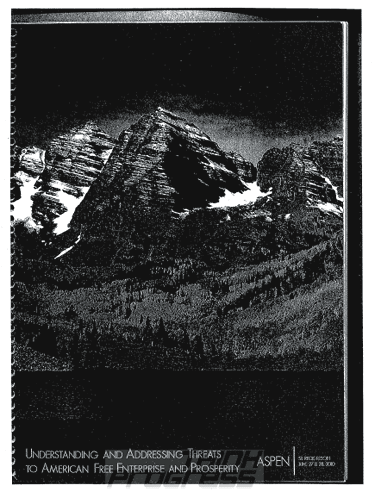
Think Progress — which should be called Think Soros because it is funded by George Soros — has released a private correspondence sent out by Charles Koch of Koch Industries. The memo has the itinerary of a private meeting to be held at an exclusive hotel in Aspen attached.
thinksorosleak.png
Soros globalists leak neocon RINO document. Click here to read PDF.
In the memo, Koch says his group of neocons and RINOs plan to “change the balance of power in Congress this November.” In other words, give power back to a Republican-dominated set of globalists and statists who hope to come out the winners in the perpetual game of musical chairs as the corrupt Mafioso government continues its slow motion Titanic routine to the bottom.
Koch plans to “activate citizens,” that is to say convince them to vote for Republicans and trademark Tea Party operatives who buy into the neocon philosophy.
The hand of the neocons weighs heavily on this invitation only, media excluded event. Charles Krauthammer will dispense his wisdom — something you can get for nothing on Fox News any day of the week — and so will stand-up comic Glenn Beck and broker-dealer Peter Schiff.
I don’t know why Schiff is speaking at this event. But then maybe I do. He’s adopted the neocon line on bombing small nations that don’t have nuclear weapons but might according to neocons who have a track record of telling lies in order to get the U.S. involved in the sort of foreign adventures George Washington warned us about. Schiff tells us to stop spending money. But then he apparently wants a huge military that can bomb small backwater countries at the drop of a hat. Go figure. Sounds awful establishment Republican to me.
Take a look at the list of people participating in this event. There are all kinds of former government insiders who will become insiders again if some RINO is elected president in 2012 and the “socialist” Dems are thrown out of the House and Senate next month. For neocons, the only socialism that works is the kind that gives the Pentagon trillions — that can subsequently disappear inside a black hole — and all kinds of fancy tax payer funded death machines to be used against the enemies of Israel, who also happen to be the enemies of the bankers.
Remember Carroll Quigely’s maxim — throw out one set of insider “rascals” for another set of insiders who follow the same basic policies.
Funny though Think Soros feels compelled to warn us about Charles Koch and the neocons when George Soros and the other faction of one-worlder neolibs are basically calling for the same thing.
Notice Obama is still in Iraq and Afghanistan and is expanding the murder campaign into Pakistan and soon enough Yemen and possibly Africa and beyond. Notice his administration is filled with Goldman Sachs cronies. Notice they will not investigate and prosecute the banksters for fleecing the public and stealing hundreds of thousands of homes right and left. Sounds pretty liberal to me. Not.
For the pencil-necked geeks and mass murder apologists at Think Soros, the Koch memo is big news. For the rest of us, it is merely an indication that nothing much changes when these control freaks and government-loving sociopaths are in power and engaged in the same old game of musical chairs.


Fresh food that lasts from eFoods Direct (Ad)

Live Superfoods It is time to Wake Up! You too, can join the "Global Political Awakening"!

Print this page

PureWaterFreedom

Tuesday, October 19, 2010

Drug Companies Hire Troubled Doctors As Experts


Fresh food that lasts from eFoods Direct (Ad)

Live Superfoods It is time to Wake Up! You too, can join the "Global Political Awakening"!

Print this page

Are you ready to evacuate?

Thursday, October 14, 2010

How to brand a disease -- and sell a cure By Carl Elliott, Special to CNN

Editor's note: Dr. Carl Elliott,an M.D. and Ph.D., is the author of "White Coat, Black Hat: Adventures on the Dark Side of Medicine" (Beacon Press, 2010).

(CNN) -- If you want to understand the way prescription drugs are marketed today, have a look at the 1928 book, "Propaganda," by Edward Bernays, the father of public relations in America.

For Bernays, the public relations business was less about selling things than about creating the conditions for things to sell themselves. When Bernays was working as a salesman for Mozart pianos, for example, he did not simply place advertisements for pianos in newspapers. That would have been too obvious.

Instead, Bernays persuaded reporters to write about a new trend: Sophisticated people were putting aside a special room in the home for playing music. Once a person had a music room, Bernays believed, he would naturally think of buying a piano. As Bernays wrote, "It will come to him as his own idea."

Just as Bernays sold pianos by selling the music room, pharmaceutical marketers now sell drugs by selling the diseases that they treat. The buzzword is "disease branding."

To brand a disease is to shape its public perception in order to make it more palatable to potential patients. Panic disorder, reflux disease, erectile dysfunction, restless legs syndrome, bipolar disorder, overactive bladder, ADHD, premenstrual dysphoric disorder, even clinical depression: All these conditions were once regarded as rare until a marketing campaign transformed the brand.

Once a branded disease has achieved a degree of cultural legitimacy, there is no need to convince anyone that a drug to treat it is necessary. It will come to him as his own idea.

Disease branding works especially well for two kinds of conditions. The first is the shameful condition that can be destigmatized. For instance, when Pharmacia launched Detrol in the late 1990s, the condition the drug treated was known to doctors as "urge incontinence." Patients called it "accidentally peeing in my pants" and were embarrassed to bring it up with their physicians.

Pharmacia fixed the problem by rebranding the condition as "overactive bladder." Whereas "incontinence" suggested weakness and was associated mainly with elderly women, the phrase "overactive bladder" evoked a supercharged organ frantically working overtime.

To qualify for a diagnosis of "overactive bladder," patients did not actually have to lose bladder control." They simply needed to go to the bathroom a lot.

The vice president of Pharmacia, Neil Wolf, explained the branding strategy in a 2002 presentation called "Positioning Detrol: Creating a Disease." By creating the disease of "overactive bladder," Wolf claimed, Pharmacia created a market of 21 million potential patients.

Another good candidate for branding is a condition that can be plausibly portrayed as under-diagnosed. Branding such a condition assures potential patients that they are part of a large and credible community of sufferers. For example, in 1999, the FDA approved the antidepressant Paxil for the treatment of "social anxiety disorder," a condition previously known as "shyness."

See more CNN.com opinion articles

In order to convince shy people they had social anxiety disorder, GlaxoSmithKline, the maker of Paxil, hired a PR firm called Cohn and Wolfe. Cohn and Wolfe put together a public awareness campaign called "Imagine being allergic to people," which was allegedly sponsored by a group called the "Social Anxiety Disorders Coalition."

GlaxoSmithKline also recruited celebrities like Ricky Williams, the NFL running back, and paid them to give interviews to the press about their own social anxiety disorder. Finally, they hired academic psychiatrists working on social anxiety disorder and sent them out on the lecture circuit in the top 25 media markets.

The results were remarkable. In the two years before Paxil was approved for social anxiety, there were only about 50 references to social anxiety disorder in the press. But in 1999, during the PR campaign, there were over a billion references.

Within two years Paxil had become the seventh most profitable drug in America, and Cohn and Wolfe had picked up an award for the best PR campaign of 1999. Today, social anxiety disorder, far from being rare, is often described as the third most common mental illness in the world.

It is hard to brand a disease without the help of physicians, of course. So drug companies typically recruit academic "thought leaders" to write and speak about any new conditions they are trying to introduce. It also helps if the physicians believe the branded condition is dangerous.

When AstraZeneca introduced Prilosec (and later Nexium) for heartburn, for example, it famously repositioned heartburn as "gastroesophageal reflux disease," or GERD. But it also commissioned research to demonstrate the devastating consequences of failing to treat it.

If all drugs were harmless, disease branding would be relatively harmless, too. But no drug is completely benign.

For example, Detrol can make elderly people delirious and may cause memory problems. Paxil is associated with sexual dysfunction and dependence. It also carries a black-box warning for suicide in children and adolescents. Side effects like these are a part of every drug. But they are never part of the brand.

The opinions expressed in this commentary are solely those of Carl Elliott.

http://edition.cnn.com/2010/OPINION/10/11/elliott.branding.disease/index.html

Follow Me!

Fresh food that lasts from eFoods Direct (Ad)

Live Superfoods It is time to Wake Up! You too, can join the "Global Political Awakening"!

Print this page
Are you ready to evacuate?

Mining The Real Story

Mark Seddon 
Big Think


The World has watched and cheered to the rafters the human drama unfolding in Chile. That thirty three miners could be trapped underground for two months, survive and be winched to the surface in a capsule that looked as though it was once used in Star Trek is an extraordinary and joyous thing.  To watch the faces of the families, of the rescuers, of the ordinary Chileans has been to experience something refreshing for a change – the victory of hope over despair.
Twenty four television coverage has allowed the World a front row seat on the human drama that has been unfolding. This is a story of course made for television, but shortly the caravan will move on. Perhaps the next great human drama won’t have such a happy ending, but even with this one at the San Jose mine, the bulk of the media shows scant interest in the conditions that led the miners to be trapped there in the first place. Why it was that the mining company, in a race for profit, sent miners into dangerous sections of the mine. There has been little effort even to send a reporting team beyond the mine to find out how people scratch a living from the edge of the desert, why it is so many were forced to this area to simply find work and what is it really like to work deep underground.
Miners the World over will not be surprised by any of this. Of course they will have delighted at the great rescue, for miners and their families are traditionally rooted in basic solidarity. For any miner whoever thought he could function as an individual and not as part of a team would never last long. But miners by the nature of their work underground are all too often unseen and overlooked. In Chile they work dangerous seams far from the public eye – and the drive for profit all too frequently does not mean that ‘safety comes first’.
I have been down coalmines in Wales, England, Poland and Outer Mongolia, and while the British mining industry had a much safer record than that of China, the job of digging the coal for the nation’s power stations was still an extremely tough and dangerous job. Miners in the old Communist states were eulogised as ‘heroes of labour’, and used to enjoy better wages than some other groups of workers, but today, wherever you look, from the diamond and gold mines of the South African reef, to the coal mines of the Donbas and Polish Silesia, miners do not get the respect and the reward they deserve. China’s mines remain some of the most dangerous in the World.
In Britain, in 1984, the bulk of Britain’s 200,000 coal miners went on strike in order to prevent their industry from being more or less shut down. That year long strike, a dispute marked by terrible hardship and suffering showed Britain at its best – through its mining communities. They lost, and a once great industry is gone. Those hundreds of thousands of miners faced years of unemployment, and frequently ill health. They were not marooned underground for two months like the Chilean miners, but they were abandoned in a different way. Which is why I imagine that miners, the World over to day, would appreciate it if the media spent just a little bit of time reporting the other side of the story. Their story.
Resources:
Efood that lasts from eFoods Direct (Ad)

Live Superfoods It is time to Wake Up! You too, can join the "Global Political Awakening"!

Print this page

Are you ready to evacuate?

Thursday, October 7, 2010

Who Owns The Media? The 6 Monolithic Corporations That Control Almost Everything We Watch, Hear And Read

https://www.adbusters.org/files/downloads/jpgs/adbusters_corporate_flag.jpg
 Back in 1983, approximately 50 corporations controlled the vast majority of all news media in the United States.  Today, ownership of the news media has been concentrated in the hands of just six incredibly powerful media corporations.  These corporate behemoths control most of what we watch, hear and read every single day.  They own television networks, cable channels, movie studios, newspapers, magazines, publishing houses, music labels and even many of our favorite websites. Sadly, most Americans don't even stop to think about who is feeding them the endless hours of news and entertainment that they constantly ingest.  Most Americans don't really seem to care about who owns the media.  But they should.  The truth is that each of us is deeply influenced by the messages that are constantly being pounded into our heads by the mainstream media.  The average American watches 153 hours of television a month.  In fact, most Americans begin to feel physically uncomfortable if they go too long without watching or listening to something.  Sadly, most Americans have become absolutely addicted to news and entertainment and the ownership of all that news and entertainment that we crave is being concentrated in fewer and fewer hands each year.      
The six corporations that collectively control U.S. media today are Time Warner, Walt Disney, Viacom, Rupert Murdoch's News Corp., CBS Corporation and NBC Universal.  Together, the "big six" absolutely dominate news and entertainment in the United States.  But even those areas of the media that the "big six" do not completely control are becoming increasingly concentrated. For example, Clear Channel now owns over 1000 radio stations across the United States.  Companies like Google, Yahoo and Microsoft are increasingly dominating the Internet.
But it is the "big six" that are the biggest concerns.  When you control what Americans watch, hear and read you gain a great deal of control over what they think.  They don't call it "programming" for nothing. 
Back in 1983 it was bad enough that about 50 corporations dominated U.S. media.  But since that time, power over the media has rapidly become concentrated in the hands of fewer and fewer people....
In 1983, fifty corporations dominated most of every mass medium and the biggest media merger in history was a $340 million deal. … [I]n 1987, the fifty companies had shrunk to twenty-nine. … [I]n 1990, the twenty-nine had shrunk to twenty three. … [I]n 1997, the biggest firms numbered ten and involved the $19 billion Disney-ABC deal, at the time the biggest media merger ever. … [In 2000] AOL Time Warner’s $350 billion merged corporation [was] more than 1,000 times larger [than the biggest deal of 1983].
--Ben H. Bagdikian, The Media Monopoly, Sixth Edition, (Beacon Press, 2000), pp. xx—xxi
Today, six colossal media giants tower over all the rest.  Much of the information in the chart below comes from mediaowners.com.  The chart below reveals only a small fraction of the media outlets that these six behemoths actually own....
Time Warner
Home Box Office (HBO)
Time Inc.
Turner Broadcasting System, Inc.
Warner Bros. Entertainment Inc.
CW Network (partial ownership)
TMZ
New Line Cinema
Time Warner Cable
Cinemax
Cartoon Network
TBS
TNT
America Online
MapQuest
Moviefone
Castle Rock
Sports Illustrated
Fortune
Marie Claire
People Magazine
Walt Disney
ABC Television Network
Disney Publishing
ESPN Inc.
Disney Channel
SOAPnet
A&E
Lifetime
Buena Vista Home Entertainment
Buena Vista Theatrical Productions
Buena Vista Records
Disney Records
Hollywood Records
Miramax Films
Touchstone Pictures
Walt Disney Pictures
Pixar Animation Studios
Buena Vista Games
Hyperion Books
Viacom
Paramount Pictures
Paramount Home Entertainment
Black Entertainment Television (BET)
Comedy Central
Country Music Television (CMT)
Logo
MTV
MTV Canada
MTV2
Nick Magazine
Nick at Nite
Nick Jr.
Nickelodeon
Noggin
Spike TV
The Movie Channel
TV Land
VH1
News Corporation
Dow Jones & Company, Inc.
Fox Television Stations
The New York Post
Fox Searchlight Pictures
Beliefnet
Fox Business Network
Fox Kids Europe
Fox News Channel
Fox Sports Net
Fox Television Network
FX
My Network TV
MySpace
News Limited News
Phoenix InfoNews Channel
Phoenix Movies Channel
Sky PerfecTV
Speed Channel
STAR TV India
STAR TV Taiwan
STAR World
Times Higher Education Supplement Magazine
Times Literary Supplement Magazine
Times of London
20th Century Fox Home Entertainment
20th Century Fox International
20th Century Fox Studios
20th Century Fox Television
BSkyB
DIRECTV
The Wall Street Journal
Fox Broadcasting Company
Fox Interactive Media
FOXTEL
HarperCollins Publishers
The National Geographic Channel
National Rugby League
News Interactive
News Outdoor
Radio Veronica
ReganBooks
Sky Italia
Sky Radio Denmark
Sky Radio Germany
Sky Radio Netherlands
STAR
Zondervan
CBS Corporation
CBS News
CBS Sports
CBS Television Network
CNET
Showtime
TV.com
CBS Radio Inc. (130 stations)
CBS Consumer Products
CBS Outdoor
CW Network (50% ownership)
Infinity Broadcasting
Simon & Schuster (Pocket Books, Scribner)
Westwood One Radio Network
NBC Universal
Bravo
CNBC
NBC News
MSNBC
NBC Sports
NBC Television Network
Oxygen
SciFi Magazine
Syfy (Sci Fi Channel)
Telemundo
USA Network
Weather Channel
Focus Features
NBC Universal Television Distribution
NBC Universal Television Studio
Paxson Communications (partial ownership)
Trio
Universal Parks & Resorts
Universal Pictures
Universal Studio Home Video
These gigantic media corporations do not exist to objectively tell the truth to the American people.  Rather, the primary purpose of their existence is to make money.
These gigantic media corporations are not going to do anything to threaten their relationships with their biggest advertisers (such as the largest pharmaceutical companies that literally spend billions on advertising), and one way or another these gigantic media corporations are always going to express the ideological viewpoints of their owners.
Fortunately, an increasing number of Americans are starting to wake up and are realizing that the mainstream media should not be trusted.  According to a new poll just released by Gallup, the number of Americans that have little to no trust in the mainstream media (57%) is at an all-time high.
That is one reason why we have seen the alternative media experience such rapid growth over the past few years.  The mainstream media has been losing credibility at a staggering rate, and Americans are starting to look elsewhere for the truth about what is really going on.
Do you think that anyone in the mainstream news would actually tell you that the Federal Reserve is bad for America or that we are facing a horrific derivatives bubble that could destroy the entire world financial system?  Do you think that anyone in the mainstream media would actually tell you the truth about the deindustrialization of America or the truth about the voracious greed of Goldman Sachs?
Sure there are a few courageous reporters in the mainstream media that manage to slip a few stories past their corporate bosses from time to time, but in general there is a very clear understanding that there are simply certain things that you just do not say in the mainstream news.
But Americans are becoming increasingly hungry for the truth, and they are becoming increasingly dissatisfied with the dumbed down pablum that is passing as "hard hitting news" these days.
So what do you think about the state of the mainstream media?  Please feel free to leave a comment with your opinion below....

Fresh food that lasts from eFoods Direct (Ad)

Live Superfoods It is time to Wake Up! You too, can join the "Global Political Awakening"!

Print this page
Are you ready to evacuate?
Jasper Roberts Consulting - Widget