Translate

GPA Store: Featured Products

Showing posts with label PSYCHOLOGY. Show all posts

Saturday, July 19, 2014

The Bernaysian Manipulation of the Human Psyche


Steven MacMillan

Edward Bernays was the master of influencing and shaping public opinion who developed upon the ideas of earlier social psychologists and the work of his uncle, Sigmund Freud, in order to create techniques to manipulate the subconscious desires of the masses.

Throughout his 103-year lifespan, the “father of public relations” was at the pinnacle of his field advising US Presidents Coolidge, Eisenhower, Hoover and Wilson, as well as inventor Thomas Edison, US industrialist Henry Ford and First Lady Eleanor Roosevelt. He also reportedly refused invitations by Hitler and Franco to work on fascist propaganda campaigns in Europe.

At the end of World War 1 Bernays served as a propagandist for America before going on to work with various government departments and corporations throughout his lifetime, including: the US Department of State, CBS, Procter and Gamble, and the American Tobacco Company, as well as designing the propaganda campaign for the United Fruit Company which led to the CIA coup against the Guatemalan President Jacobo Árbenz in 1954. 

Bernays combined the work of people such as the French social psychologist Gustave Le Bon to create techniques which appeal to the subconscious emotions of the public, as opposed to engaging the public in rational and intellectual debate. Le Bon studied the mental characteristics and the behaviour of the crowd, believing that when part of a mass, individuals are subordinate to the crowd mind and that a human behaves in a more emotive, irrational manner. Bernays observed that if a propagandist could understand the “motives of the group mind”, they would possess the ability to “control and regiment the masses”: 

Wednesday, May 22, 2013

The Psychology of Evil


Enter your email address to subscribe to our newsletter:


Delivered by FeedBurner
Be the Change! Share this using the tools below.

The Psychology of Authority


“If we’ve been bamboozled long enough, we tend to reject any evidence of the bamboozle. We’re no longer interested in finding out the truth. The bamboozle has captured us. It’s simply too painful to acknowledge, even to ourselves, that we’ve been taken. Once you give a charlatan power over you, you almost never get it back.” 
‒Carl Sagan


Related Article:

The Psychology of Tyranny vs. the Nature of Conformity


Enter your email address to subscribe to our newsletter:


Delivered by FeedBurner
Be the Change! Share this using the tools below.

Tuesday, November 23, 2010

Thank You. No, Thank You

Editor's Note:  Considering the many problems we face in life, it may seem almost impossible, at times, to find any room for positive thoughts and gratitude.  However, gratitude is essential to one's overall emotional, psychological, and physical well-being.


Wall Street Journal


It turns out, giving thanks is good for your health.
A growing body of research suggests that maintaining an attitude of gratitude can improve psychological, emotional and physical well-being.
Adults who frequently feel grateful have more energy, more optimism, more social connections and more happiness than those who do not, according to studies conducted over the past decade. They're also less likely to be depressed, envious, greedy or alcoholics. They earn more money, sleep more soundly, exercise more regularly and have greater resistance to viral infections.
Now, researchers are finding that gratitude brings similar benefits in children and adolescents. Kids who feel and act grateful tend to be less materialistic, get better grades, set higher goals, complain of fewer headaches and stomach aches and feel more satisfied with their friends, families and schools than those who don't, studies show.
"A lot of these findings are things we learned in kindergarten or our grandmothers told us, but we now have scientific evidence to prove them," says Jeffrey J. Froh, an assistant professor of psychology at Hofstra University in Hempstead, N.Y., who has conducted much of the research with children.
"The key is not to leave it on the Thanksgiving table," says Robert Emmons, a professor of psychology at the University of California-Davis and a pioneer in gratitude research. And, he notes, "with the realization that one has benefited comes the awareness of the need to reciprocate."
Philosophers as far back as the ancient Greeks and Romans cited gratitude as an indispensable human virtue, but social scientists are just beginning to study how it develops and the effects it can have.
The research is part of the "positive psychology" movement, which focuses on developing strengths rather than alleviating disorders. Cultivating gratitude is also a form of cognitive-behavioral therapy, which holds that changing peoples' thought patterns can dramatically affect their moods.
It's possible, of course, to over-do expressions of gratitude, particularly if you try to show it with a gift. "Thanking someone in such a way that is disproportionate to the relationship—say, a student giving her teacher an iPod—will create resentment, guilt, anger and a sense of obligation," says Dr. Froh.
Gratitude can also be misused to exert control over the receiver and enforce loyalty. Dr. Froh says you can avoid this by being empathic toward the person you are thanking—and by honestly assessing your motivations.
In an upcoming paper in the Journal of Happiness Studies, Dr. Froh and colleagues surveyed 1,035 high-school students and found that the most grateful had more friends and higher GPAs, while the most materialistic had lower grades, higher levels of envy and less satisfaction with life. "One of the best cures for materialism is to make somebody grateful for what they have," says Dr. Froh.
Much of the research on gratitude has looked at associations, not cause-and-effect relationships; it's possible that people who are happy, healthy and successful simply have more to be grateful for. But in a landmark study in the Journal of Personality and Social Psychology in 2003, Dr. Emmons and University of Miami psychologist Michael McCullough showed that counting blessings can actually make people feel better.
The researchers randomly divided more than 100 undergraduates into three groups. One group was asked to list five things they were grateful for during the past week for 10 consecutive weeks. The second group listed five things that annoyed them each week and the third group simply listed five events that had occurred. They also completed detailed questionnaires about their physical and mental health before, during and after.
Those who listed blessings each week had fewer health complaints, exercised more regularly and felt better about their lives in general than the other two groups.
Drs. Froh and Emmons conducted a similar study with 221 sixth- and seventh-graders from Candlewood Middle School in Dix Hills, N.Y., an affluent area on Long Island. Although the effects weren't as dramatic as with the adults, the students in the gratitude group did report a higher level of satisfaction with school and more optimism than the students who listed irritations, according to the study in the Journal of School Psychology in 2008.
As simple as it sounds, gratitude is actually a demanding, complex emotion that requires "self-reflection, the ability to admit that one is dependent upon the help of others, and the humility to realize one's own limitations," Dr. Emmons says.
Being grateful also forces people to overcome what psychologists call the "negativity bias"—the innate tendency to dwell on problems, annoyances and injustices rather than upbeat events. Focusing on blessings can help ward off depression and build resilience in times of stress, grief or disasters, according to studies of people impacted by the Sept. 11 terror attacks and Hurricane Katrina.
Fresh food that lasts from eFoods Direct (Ad)

Live Superfoods It is time to Wake Up! You too, can join the "Global Political Awakening"!

Print this page

PureWaterFreedom

Monday, September 20, 2010

Truth and Peace: How To Be A Peaceful, Happy, Truth Seeking Activist

by Mark Daniels
Global Political Awakening


The people who are involved in some way with social and political activism must find a way to maintain a sense of peace and serenity in the midst of some rather troubling information and facts.  While seeking to expose government and corporate corruption, modern day eugenics and population control strategies, the global conspiracy to enslave the masses, and much, much more; activists, writers, journalists, artists and others must also take the time to "take care of oneself" physically, emotionally, and spiritually.  A balanced life is essential to maintaining the energy and strength necessary to push forward against the ever increasingly oppressive organizations and institutions whose members seek to protect and maintain their power and control.   As Zbigniew Brzezinski recently stated "There is a new and unique development in human history that is taking place around the world; it is unprecedented in reach and volume, and it is also the greatest threat to all global power structures: the ‘global political awakening.’ 


How To Be Happy


"Positive psychology is a movement in social psychology which attempts to change the way that we think about humans," explains positive psychology expert Shawn Achor. "Instead of focusing merely on the average, which is what we normally do in traditional psychology—we would find out what the average person is like, or how the average person responds—instead, what we look at are people who are up above the curve for some given dimension. Maybe that means that they are extremely energetic, that they are very happy, they’re very productive.  And our goal is to find out why that is."

In his Big Think interview, Achor, the author of "The Happiness Advantage," tells us that, unlike regular psychology, which focuses on the average or below average, he studies people who are in some way exceptional, with the hopes of applying that knowledge to the greater population. 
We can actually reprogram our brains to be happier, says Achor. "The brain is like a single processor in a computer." Someone who is chronically negative or pessimistic is merely scanning first for the stresses and the hassles of life. And because the brain has finite resources, it cannot also scan for the positive elements. As a result, that person continuously reinforces his own negativity, causing himself to feel unhappy. The key to positive psychology is training the mind to divert its resources in a different way, finding ways to be optimistic and reasons to be grateful. After a period of about 21 days, the pattern of positive thinking can be retrained permanently in the brain, something Achor calls the Tetris Effect. And he tells us five ways that we can be happier by harnessing this Tetris Effect. 
And you can not only change your own outlook but also influence that of the people around you, something that has always been known but never fully understood. It has to do with something called "mirror neurons" in your brain. "These mirror neurons are the reason why a yawn spreads at board meetings," Achor explains. "Your brian, when you see something in your visual field, raises the likelihood of your experiencing that as well." The same goes for positivity—as well as negativity—which is why leaders can have such a profound effect in business.  "You can have one person in the room that is very expressive of their negativity and stress and it can spread to the entire team," Achor says. He also gives several other pieces of advice about leveraging the happiness advantage in the business world
Ultimately, Achor wants people to understand that happiness should not be kept on our cognitive horizons; it is not something that will magically appear after reaching a certain level in a company or a school. "Happiness is a work ethic," Achor says. "It's something that requires our brains to train just like an athlete has to train.  
Training oneself to be happier is an essential ingredient in one's overall level of peace and serenity.  For a more in depth analysis, you can read Shawn's book, The Happiness Advantage: The Seven Principles of Positive Psychology That Fuel Success and Performance at Work.  Additionally, we may find solace in a spiritual discipline which can allow us to escape from the tireless efforts of fighting for peace and justice for all.
Of course, exercise and nutrition are basic building blocks for increased physical and mental energy which contribute greatly to one's overall level of happiness.
We must constantly guard against the tendency to allow our well-intentioned activism to direct and control our lives to the exclusion of personal peace and serenity.
Fresh food that lasts from eFoods Direct (Ad) 


Live Superfoods It is time to Wake Up! You too, can join the "Global Political Awakening"! 


Print this page

Friday, September 10, 2010

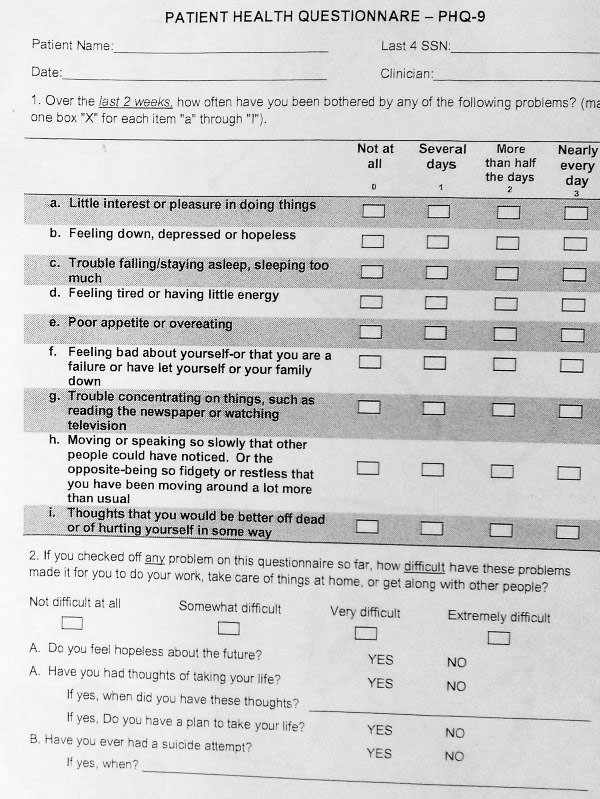
Doctors Giving Veterans Questionnaire to Determine Mental Illness

Infowars.com
September 10, 2010
The FederalJack website has posted a video and form today revealing how the government is attempting to categorize veterans as mentally ill. The video and form follow.
In 2007, HR 2640 was introduced by notorious gun grabbers Carolyn McCarthy and Patrick Leahy, both Democrats (Leahy introduced his bill in the Senate).
“Anyone who is diagnosed as being a tiny danger to himself or others would have his gun rights taken away … forever. It is section 102(b)(1)(C)(iv) in HR 2640 that provides for dumping raw medical records into the system,”Larry Pratt, executive director of of Gun Owners of America, wrote when the bill came to light. “Forget the fact that people with PTSD have the same violent crime rate as the rest of us. Vietnam vets with PTSD have had careers and obtained permits to carry firearms concealed. It will now be enough for a psychiatric diagnosis (a ‘determination’ in the language of the bill) to get a veteran barred — for life — from owning guns”
On June 13, 2007, the bill was passed in the House and on December 19, 2007, the Senate version was passed.
Now the doctors are told they have to fill out the “Patient Health Questionnare” (sic) below. If this is in fact a legitimate document, it will facilitate the effort to disarm America’s veterans.

Live Superfoods It is time to Wake Up! You too, can join the "Global Political Awakening"!

Print Page 

Wednesday, September 8, 2010

So Broke We Can't Pay Attention

You spent the whole day yesterday worrying about today, and now that it's here, was it worth it?


Howard Beale

It's a scary feeling not being able to pay your bills.  It can be so stressful that it consumes the entirety of our thoughts and emotions.  We may fight with our spouses, or prematurely snap at our children over meaningless nonsense because we are constantly on edge over finances.  

Day after day, week after week, month after month we live stressed to the max.  If we're able to break our funk trance for a moment and look back, we just may realize that all of the agonizing was not worth it as, somehow, we made it to today in one piece.

An excellent article this week on the Economic Collapse Blog decisively proved that is impossible for a family of four to survive in America on a middle-class income of $50,000 per year.  Since more than half of the U.S. population makes less than that amount, and another 35% of American families make less than $100,000 per year; we can only assume that the overwhelming majority of the population lives with chronic financial-stress syndrome -- which Big Pharma will happily treat for us.

This 85% of the population has little time or energy to think of much else.  In other words, we're so broke we can't pay attention to the world around us -- which is what the system was designed to do. The system keeps us running on the rat wheel, terrified it will stop, or that our employers will kick us off. 

We become so primal about defending our position, our sustenance, that we ignore our basic humanity. Who has time to think about such things like other people's problems?  The system turns us against our neighbors in an ultra-competitive dog-eat-dog economy.  And if that doesn't work they'll use religion, race, or politics to divide us.  Scratch that; they use it all, all the time. 

The public is kept in a constant state of dense negative energy, where we inevitably contaminate those around us with bad vibes, who then pass them on to their peers and so on.

Sooner or later we live in dense, negative, selfish society.  This denseness has even affected the crowd that can afford to pay attention, because they are aware of the sinister methods being used to keep humanity within our shrinking prison walls.  Thankfully for us, this prison of stress and manufactured division is an illusory distraction that we can ultimately free ourselves from.

Sure, we all have very real concerns about paying bills and putting food on the table.  However, we must fully appreciate that we are alive and well today, just as we were three months ago when we were stressed out of our minds.    

We lived the last three months in constant discomfort, distracted from reality and, despite all that, we survived.  Would it not have been better to spend those three months with a positive attitude, or at least a level of comfort knowing that we'll be fine no matter what the system throws at us?  

Perhaps with this slight adjustment in attitude, we might find that we do have time to pay attention and be more productive in ways that go beyond finances.  In fact, we may even attract abundance to ourselves if we understand (not just believe) that positive thoughts and energy will attract the same to us.  

Surely it must be better than the alternative, which is letting the system manufacture our emotions for us.  Especially when the goal of such system engineering is to keep us in a perpetual state of non-thinking denseness that limits our potential to that of a rat in a seemingly inescapable maze. 

Our individual potential is only limited to what we allow ourselves to imagine.  In a world of decreasing personal freedoms, we each have the power to bust out of the cage of denseness into real liberty -- liberty of the mind.

So today, let's each take some time to concentrate on positive things like love, laughter, and joy -- if even for a few quiet minutes. Let a genuine smile overtake you.  Beam those feelings of love and joy to the people around you.  If you think it's hokey, just do it as a calculated experiment to see how it affects your day.  Finally, we must believe, know, and fully accept that we will be okay no matter what perceived chaos surrounds us.

Recent Articles by Howard Beale:
Are We Witnessing the Death of Our Planet?
The Great Gay Distraction Perfectly Timed For November Elections


Live Superfoods It is time to Wake Up! You too, can join the "Global Political Awakening"!
Jasper Roberts Consulting - Widget