Translate

GPA Store: Featured Products

Showing posts with label OIL SPILL. Show all posts

Saturday, March 30, 2013

Clean up begins for Mayflower, Arkansas Oil Spill

Amy Hancock
KTHV

It was a rough start to the Easter holiday weekend after an oil spill struck in Mayflower. Authorities said as many as 40 homes had to be evacuated Friday afternoon. 

Mayflower Police Chief Robert Satkowski said that the evacuations will remain in effect over-night. The chief also stated that it's too early to say how much oil spilled, but crews have prevented it from getting into Lake Conway. That was a big concern all day; the work ahead will focus on clean-up around the affected areas in town. 

"So that is a pipeline that has busted and has flooded the neighborhood," said THViewer Drew Barnes, who gave THV 11 video of the Northwoods subdivision in Mayflower Friday. 

Authorities said it's a mess triggered by an Exxon Mobile crude oil pipeline that ruptured, spewing out oil Friday afternoon. 

"The smell is unbelievable. I mean, look!" Barnes said as he shot the video of his neighborhood. 

The United States Environmental Protection Agency has been on scene with air monitors, going through the neighborhoods to determine if the air quality has been effected. 

"A lot is all that I can estimate," Chief Satkowski said of the spilled oil. "It flowed from approximately 2:45p.m. when it was discovered by a homeowner to after 3 p.m. I want to say almost 3:30." 

Chief Satkowski said it's not clear why the pipeline ruptured, but it was later shut off by Exxon. 

The spill prompted evacuations as clean-up crews tackled some drainage areas in town where the oil flowed to. Along Highway 89 across from Lake Conway, crews sealed off two pipes under the road to keep oil from flowing from a city drainage pond into the lake. 

"I'm just over here trying to make sure that we get it stopped before it gets into the lake because we'll have a real problem," Mayor Randy Holland said. 

Mayor Randy Holland was also on the scene Friday where authorities did manage to keep the lake from any contamination, but it still turned the start of the holiday weekend upside down in Mayflower. 

"Incredible and that is oil," Barnes said, as his camera rolled. 

As for the residents who had to leave their homes, the police chief said he's not aware of any that requested shelter assistance, but he did say that Exxon Mobil has said the company will put folks up in a hotel if need be. 

There's no official word yet on how long it will take to clean up the mess and when residents can return home. 

THV 11 spoke via phone to Satkowski early Saturday morning for an update. He says that while cleanup continues, the rain is causing problems. 

"It complicates from a manpower standpoint and it causes some of the cleanup material not to absorb as well," he says. 

ExxonMobil said it's investigating the cause and working with local authorities in clean-up efforts. The company added that the breach was in a pipeline that originates in Illinois and carries crude oil to the Texas Gulf Coast. 

Representatives with Conway Corporation posted a Facebook status that read, "Lake Conway is not Conway's water source. We get our water from Lake Brewer, located north of Plumerville in Conway County. The oil spill being reported does not impact Conway's water supply."

Enter your email address to subscribe to our newsletter:


Delivered by FeedBurner
Be the Change! Share this using the tools below. Sharing on Reddit and Newsvine will help the most.

Wednesday, September 15, 2010

National Security Used As Pretext to Confiscate Samples and Notes On Dispersant

Florida Oil Spill Law

Science in the Gulf, NPR Science Friday, August 20, 2010:
Transcript Excerpt
FLATOW, HOST: Yeah, let me to go the phones, Darren(ph) in College Station, Texas. Hi, Darren.
DARREN (Caller): Hello, Ira.
FLATOW: Hi, there.
DARREN: I’m an adjunct professor here at A&M, and we were also in the Gulf, but got thrown out. We were testing a theory that the chemical composition of the dispersant they were using was causing the oil to sink. And we’d been there for approximately three days, and federal agents flat told us to get out. And it wasn’t Fish and Wildlife officers. These were Homeland Security officers, and we were told that it was in the interest of national security.
CARY NELSON, president, American Association of University Professors,: I mean, I could see restricting access so that 500 people shouldn’t be able to ride their dune buggies along the beach, but reputable scientists should have access.
FLATOW: Darren, did take your samples away or anything – take anything away from you?
DARREN: Oh, yeah, they inspected the boat. They, of course, checked everyone’s identification, and they took all the samples that we had. And they also took some notes that we had. The theory that we were operating upon was information that had been given to us by someone who worked in the plant that made that dispersant. And they took everything.
FLATOW: Wow.
DARREN: (unintelligible)…
Prof. NELSON: Ira, it’s really kind of an insane world that we’ve entered into in terms of the barring of reputable scientists from a public site where they can contribute considerably to the knowledge that we have.
FLATOW: Dr. D’Elia, do you know of other cases like Darren’s?
Dr. CHRISTOPHER D’ELIA, professor and dean, School of The Coast and Environment, Louisiana State University: Yes, I’ve heard of other cases…
See the report here.


Live Superfoods It is time to Wake Up! You too, can join the "Global Political Awakening"! Print this page

Sunday, September 12, 2010

Millions of migrating birds heading to oil

The marshes, shores and islands of Gulf Coast are a bottleneck for birds heading south


Larry O'Hanlon
MSNBC

Nearly five million Migratory birds from Canada are now winging their way south across North America, and many of them could be in for a nasty shock when they reach the oily marshes and beaches along the Gulf Coast.

"There’s a lurking time bomb for many waterfowl and shorebirds that breed in Canada's boreal forest and winter or stop in the Gulf," said Jeff Wells, senior scientist at the Boreal Songbird Initiative.

There are several concerns ornithologists have about the birds. First of all, they could come into direct contact with oil that's present in many salt marshes, as well as just under the surface of shores and islands off Louisiana.

Then there is the problem of food. Many shorebirds eat small invertebrates that live in the sand along the shore. Now a lot of that sand is saturated with oil just below the surface, which has wiped out the invertebrates.

"The birds are actually dipping their bills down into the oil," said Wells.

The marshes, shores and islands of the Gulf Coast are a bottleneck for birds heading south, as they provide the last chance for many of these birds to fatten up before flying 500 miles across the Gulf to their wintering grounds in the Caribbean or South America. It's arguably one of the word's the worst places to have a major environmental disaster, said Melanie Driscoll, director of bird conservation for the National Audubon Society's Louisiana Coastal Initiative.

In order to see whether migrating birds get mired directly in oil, or if there are any other surprises in bird behavior or health due to the oil spill, the Audubon Society is planning on expanding teams of volunteer and professional bird watchers to monitor what happens in the coming months, and even years.

Read Full Article


Live Superfoods It is time to Wake Up! You too, can join the "Global Political Awakening"! Print this page

Scientists Find Thick Layer of Oil On Seafloor

Richard Harris
NPR

Scientists on a research vessel in the Gulf of Mexico are finding a substantial layer of oily sediment stretching for dozens of miles in all directions. Their discovery suggests that a lot of oil from the Deepwater Horizon didn't simply evaporate or dissipate into the water — it has settled to the seafloor.

The Research Vessel Oceanus sailed on Aug. 21 on a mission to figure out what happened to the more than 4 million barrels of oil that gushed into the water. Onboard, Samantha Joye, a professor in the Department of Marine Sciences at the University of Georgia, says she suddenly has a pretty good idea about where a lot of it ended up. It's showing up in samples of the seafloor, between the well site and the coast.


"I've collected literally hundreds of sediment cores from the Gulf of Mexico, including around this area. And I've never seen anything like this," she said in an interview via satellite phone from the boat.

Joye describes seeing layers of oily material — in some places more than 2 inches thick — covering the bottom of the seafloor.

"It's very fluffy and porous. And there are little tar balls in there you can see that look like microscopic cauliflower heads," she says.

It's very clearly a fresh layer. Right below it she finds much more typical seafloor mud. And in that layer, she finds recently dead shrimp, worms and other invertebrates.

'A Slime Highway'

How did the oily sediment get there? Joye says it's possible that chemical dispersants might have sunk some oil, but it's also likely that natural systems are playing an important role.

"The organisms that break down oil excrete mucus — copious amounts of mucus," Joye says. "So it's kind of like a slime highway from the surface to the bottom. Because eventually the slime gets heavy and it sinks."

That sticky material can pick up oil particles as it sinks. Joye can't yet say with certainty that the oily layer is from BP's blown-out well.

Read Full Aticle

Live Superfoods It is time to Wake Up! You too, can join the "Global Political Awakening"! Print this page

Saturday, September 11, 2010

My Dogs Won't Drink the Rainwater

Tony Blizzard

Most of this week it has been raining where I live. [Arkansas] Until today it was mostly light rain but this morning there was close lightening and thunder and water coming down by inches an hour.  This water is off the Gulf of Mexico, pushed inland by the current storm in the gulf.

In the afternoon, the clouds broke up, the sun finally coming out, so I took my dogs for a walk, first chance in days.  But with the sun came truly muggy heat.  In a short time the dogs were looking for water.  They know all the places in the road ditches where we walk which are a bit deeper and hold puddles of water after a rain.  They kept going to these spots as we progressed but they wouldn't drink this fresh rain water after a lick or a smell.  Not even where it was still running freely.  Finally we hit a spot, a little deeper than the others, where the old dog did half-heartedly drink some.  But he soon ended up biting at the water before climbing out of the ditch - I've never seen him do that before.

On arriving home the dogs usually dive into an old 4 or 5 gallon mop bucket I have set to catch rain water off the roof.  But they drank very little from it today even though they were obviously thirsty.

Finally, after being in the house for some time, they drank from the well water bucket I keep in the house for them.  Now I'll have to watch how they approach the well water the next few days as these rains work their way through the earth into my well.  If my well is contaminated by rain laden with those chemicals dumped into the gulf, or with oil, I'm in trouble.  Hell, half the country is.

I trust my dogs' senses of smell and taste way over what we're told by government, academia and media.  Today there was something about this fresh rain water that they wanted no part of.


Live Superfoods It is time to Wake Up! You too, can join the "Global Political Awakening"! Print this page

Wednesday, September 8, 2010

BP report blames itself, others for oil spill

AP

NEW ORLEANS – In an internal report released Wednesday, BP blames itself, other companies' workers and a complex series of failures for the massive Gulf of Mexico oil spill and the drilling rig explosion that preceded it.
The 193-page report was posted on the company's website even though investigators have not yet begun to fully analyze a key piece ofequipment, the blowout preventer, that should have cut off the flow of oil from the ruptured well but did not.
That means BP's report is far from the definitive ruling on the blowout's causes, but it may provide some hint of the company's legal strategy — spreading the blame around between itself, rig owner Transocean, and cement contractor Halliburton — as it faces hundreds of lawsuits and possible criminal charges over the spill. Government investigators and congressional panels are looking into the cause as well.
"This report is not BP's mea culpa," said Rep. Edward J. Markey, D-Mass., a frequent BP critic and a member of a congressional panel investigating the spill. "Of their own eight key findings, they only explicitly take responsibility for half of one. BP is happy to slice up blame, as long as they get the smallest piece."
Members of Congress, industry experts and workers who survived the rig explosion have accused BP's engineers of cutting corners to save time and money on a project that was 43 days and more than $20 million behind schedule at the time of the blast.
BP's report acknowledged, as investigators have previously suggested, that its engineers and employees of Transocean misinterpreted a pressure test of the well's integrity. It also blamed employees on the rig from both companies for failing to respond to warning signs that the well was in danger of blowing out.
Outgoing BP chief Tony Hayward, who is being replaced Oct. 1 by American Bob Dudley, said in a statement that there was a bad cement job and a failure of a barrier at the bottom of the well that let oil and gas leak out.
Transocean blasted BP's report, calling it a self-serving attempt to conceal the real cause of the explosion, which it blamed on what it called "BP's fatally flawed well design."
"In both its design and construction, BP made a series of cost-saving decisions that increased risk — in some cases, severely," Transocean said.
Transocean said its own investigation will be concluded when all of the evidence is in, including critical information the company has requested of BP but has yet to receive.
New Orleans attorney Scott Bickford, who represents relatives of a worker who died in the explosion and a worker who survived the blast, said he found no surprises in the report.
"My knee-jerk reaction is that there was no huge smoking gun they found that hasn't already been discussed," he said.
An AP analysis of the report shows that the words "blame" and "mistake" never show up. "Fault" appears 20 times, but only once in the same sentence as the company's name.
Steve Yerrid, special counsel on the oil spill for Florida Gov. Charlie Crist, said the report clearly shows the company is attempting to spread blame for the well disaster, foreshadowing what will be a likely legal effort to force Halliburton and Transocean, and perhaps others, to share costs such as paying claims and government penalties.
"What's you're seeing right now is the format of BP's defense. The defense is, 'We took the initial blow. But it wasn't only me,'" Yerrid said. "They are looking to restore their losses by seeking to attribute components of the wrongdoing to others."
BP shares were up 2 percent at 414.95 pence ($6.41) in London shortly after the report was made public Wednesday.
Several divisions of the U.S. government, including the Justice Department, Coast Guard and Bureau of Ocean Energy Management, Regulation and Enforcement, are also investigating the explosion.
The blowout preventer was raised from the water off the coast of Louisiana on Saturday. As of Tuesday afternoon, it had not reached a NASA facility in New Orleans where government investigators planned to analyze it, so those conclusions were not part of BP's report.
The rig explosion killed 11 workers and sent 206 million gallons of oil spewing from BP's undersea well.
Investigators know the explosion was triggered by a bubble of methane gas that escaped from the well and shot up the drill column, expanding quickly as it burst through several seals and barriers before igniting.
But they don't know exactly how or why the gas escaped. And they don't know why the blowout preventer didn't seal the well pipe at the sea bottom after the eruption, as it was supposed to.
The details of BP's internal report were closely guarded — and only a short list of people saw it ahead of its release.
There were signs of problems prior to the explosion, including an unexpected loss of fluid from a pipe known as a riser five hours before the explosion that could have indicated a leak in the blowout preventer.
Witness statements show that rig workers talked just minutes before the blowout about pressure problems in the well.
At first, nobody seemed too worried, workers have said. Then panic set in.
Workers called their bosses to report that the well was "coming in" and that they were "getting mud back." The drilling supervisor, Jason Anderson, tried to shut down the well.
It didn't work. At least two explosions turned the rig into an inferno.
In its report, BP defended the well's design, which has been criticized by industry experts.
Other findings in the BP report include:
_Flammable fluids rising up the pipe toward the Deepwater Horizon rig were directed to a system that allowed gas to vent onto the rig, and that gas was then circulated by the air conditioning, heating and ventilation systems. BP says that if the crew had directed the fluids overboard, there might have been more time to respond to the pending disaster and the consequences of the accident may have been reduced.
_BP concluded that a "more thorough review and testing by Halliburton" and "stronger quality assurance" by BP's well team well might have identified potential flaws and weaknesses in the design for the cement job.
_BP counters the concerns that were raised prior to the explosion by Halliburton over the potential for a severe gas flow problem if a BP plan was used. Halliburton and BP were at odds over a key device, known as a centralizer, that is used as part of the process to plug a deepwater well like the oil giant was doing at the time of the disaster. Halliburton's well design expert testified previously he told BP officials April 15 — five days before the well blew — that fewer centralizers would cause a bigger gas flow problem. BP rejected Halliburton's recommendation to use 21 centralizers. Instead, BP used six. In its report Wednesday, BP said the decision likely did not contribute to the cement's failure.
In June, the House Committee on Energy and Commerce's chairmen said it was BP that made five crucial decisions before the Deepwater Horizon well blowout that "posed a trade-off between cost and well safety." One of those decisions: BP opted against conducting a certain kind of test of the integrity of a cement job at the well. The test would have cost more than $128,000 and taken 9 to 12 hours to perform, the committee's letter notes.
In May, senior BP drilling engineer Mark Hafle told the Coast Guard and Bureau of Ocean EnergyManagement investigators that BP didn't order the test even though more than 3,000 barrels of mud had been lost while drilling, a possible warning sign.
The committee also criticized BP's well design.
___
Associated Press Writers Curt Anderson in Miami, Chris Kahn in New York and Seth Borenstein in Washington contributed to this report.

Source Article
Live Superfoods It is time to Wake Up! You too, can join the "Global Political Awakening"!

Obama, Corporate Media Ignore Widespread Health Problems On Gulf Coast

Kurt Nimmo
Infowars.com
September 7, 2010
If you listen to Thad Allen, Obama’s point man on the BP oil gusher, we’re over the hump. On the weekend the former Coast Guard commander said the well no longer poses a threat to the Gulf and crews will now begin the last few remaining operations needed to abandon the well this week.
In short, Obama gets to declare another mission accomplished.
The problem has been lurking in the Gulf since the first days of the BP oil spill and now has the potential ignite a disaster unlike any this country has ever seen.
However, here is what Allen and the corporate media are not talking about — residents along the Gulf Coast are sick from the effects of the oil gusher.
“The harm dealt by this silent enemy is beginning to creep into the lives of those living and working in the Gulf. The problem has been lurking in the Gulf since the first days of the BP oil spill and now has the potential ignite a disaster unlike any this country has ever seen,” reportsProject Gulf Impact, an organization of citizen journalists who are doing what the corporate media refuses to do. “The residents of the Gulf of Mexico are entering a crisis whose scope cannot be calculated. Several symptoms have been reported, from subtle to severe: skin rashes and infections, upper respiratory burning, congestion and cough, headaches, nausea, vomiting, and neurological symptoms including short-term memory loss and coordination problems. These health problems, if acknowledged at all, are mis-diagnosed, buried, and mis-attributed.”
In August, chemist Bob Naman tested the waters off Orange Beach, Alabama, and found they tested positive for the dangerous neurotoxin pesticide 2-butoxyethanol, the main ingredient of Corexit 9527A.
Months ago we were told by the government this version of Corexit was no longer in use.
Mr. Naman apparently made a mistake by making his findings public. He was subsequently threatened by BP. “I am not certain the reason or nature of the threats or whether they were financial or physical threats, but given the sudden rash of untimely deaths of those with damaging knowledge about BP I would not take any threats from BP lightly,” Alexander Higgins wrote on August 24.
On September 1, Infowars.com carried a story about a swimming pool in Homosassa, Florida, testing positive for the Corexit 9527A marker 2-butoxyethanol. Samples were tested by Robert Naman, the thorn in BP’s side. The story was ignored by the corporate media.
For BP and the Obama administration, scrubbing the oil gusher and its untold number of victims from the front page is more important than the health of people along the Gulf coast. The Democrats want the oil gusher to go away because of the political damage it will inflict on them during the mid-term elections this November. Republicans want it to go away because they are covering BP’s back. Illness and misery will not be allowed to interrupt the political dog and pony show.
On September 18, 2001, then EPA administrator Christie Whitman announced the air at Ground Zero was safe to breathe. Experts estimate that as many as 40,000 people breathed noxious pollution, including dust, in the wake of the terrorist attack on the World Trade Center.
But the afflicted — including heroic first responders — should not expect help from the government.
The James Zadroga 9/11 Health and Compensation Act of 2009 would provide medical monitoring to those exposed to toxins, increase treatment at specialized centers for those afflicted by toxins and reopen a compensation fund to provide for the economic loss of victims. It was characterized as another Obama entitlement program by the GOP House leadership, who vowed to defeat the legislation.
If the massive poisoning of the people of the Gulf is ever exposed, we can expect a similar response on the part of the government.
  Print this page.


Live Superfoods It is time to Wake Up! You too, can join the "Global Political Awakening"!

Thursday, September 2, 2010

Breaking News! Rescue efforts underway after oil rig accident in Gulf

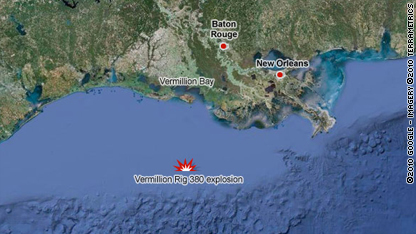
An oil rig accident has occurred in the Gulf of Mexico and rescue attempts are underway for at least 12 people, Coast Guard spokesman John Edwards told CNN. The accident took place 80 miles off the coast of Louisiana on Vermilion Oil rig 380, which is owned by Mariner Energy.

FREE trial - Get out of Debt with DebtGoal Huge Coupon Savings! 

$15 off orders of $40 or more at Botanic Choice. Free Shipping on $50 or more. Coupon Code BC15. Expires 9/30/2010]


[Posted at 11:53 a.m.] U.S. Coast Guard Petty Officer Bill Colclough tells CNN that 12 people from the rig are in the water immersion suits as they await rescue.
Colclough told CNN there are reports the rig is still on fire.
"We don't know what caused the rig to catch on fire," he told CNN, noting the incident is under investigation.
Asked about concerns regarding oil leaks or pollution, Colclough said "there are reports the rig was not actively producing any product, so we don't know if there's any risk of pollution."
[Posted at 11:43 a.m.] U.S. Coast Guard Petty Officer Bill Colclough tells CNN that all 13 workers involved in the rig explosion are accounted for, but one person is injured.
Coast Choppers are on the way to the site 80 miles south of Vermilion Bay.
[Posted at 11:33 a.m.] An oil rig has exploded 80 miles off the coast of Louisiana, with 12 people overboard and one missing, the Coast Guard said Thursday morning.
Rescue attempts are under way for at least 12 people, Coast Guard spokesman John Edwards told CNN. 13 people were on board the rig total, Edwards said, noting 12 have been accounted for, but one person was missing.
The accident took place 80 miles off the coast of Louisiana on the Vermilion Oil rig 380, which is owned by Houston-based Mariner Energy.
The Coast Guard has multiple helicopters, an airplane and several Coast Guard cutters en route. It's unknown if there are any injuries.
Jasper Roberts Consulting - Widget