

Showing posts with label Rady Ananda. Show all posts
Showing posts with label Rady Ananda. Show all posts
Monday, August 26, 2013
Thursday, August 15, 2013
Sunday, August 11, 2013
Thursday, June 27, 2013
Thursday, October 18, 2012
Friday, October 12, 2012
Tuesday, August 28, 2012
New Orleans is braced for Isaac

New Orleans has battened down the hatches, filled the gas tanks, and stocked up on survival gear in preparation for Tropical Storm (soon-to-be Hurricane) Isaac, which isexpected to make landfall Tuesday afternoon or evening, one day shy of the 7th anniversary of Hurricane Katrina.
Still emotionally shocked from that August 29, 2005 disaster, talk of “the flood” finds its way into the first or second conversation with any local. People are still processing that event, so when Isaac began posing a threat, folks here took it seriously and immediately began preparing.
To get a sense of New Orleans wit, even amid a potentially lethal event, a local radio station (WWOZ 90.7 FM) queued a long set of flood songs on Monday, including Led Zeppelin’s When the Levee Breaks. I couldn’t help but enjoy the morbid humor as I drove around town buying supplies.

Monday, July 30, 2012
Survival tips for the urbanite: Part 1 – Nuclear Radiation
Activist Post
Though many survivalists like to prepare for TEOTWAWKI (the end of the world as we know it), joblessness and homelessness have led me to the end of the world as I know it. With coffee in hand, I opened the warehouse door of my temporary digs to greet the dawn. Only, it’s noon, there’s a downpour, and the smell of rubber from a pile of decomposing tires greets me. This marks Month 4 in New Orleans and two years since I was laid off.
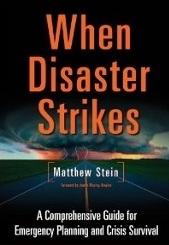
In this vein, I finally started reading Mat Stein’s two survival books, When Technology Fails (2008) and When Disaster Strikes (2011). I also headed over to Jim Rawles’ Survival Blog and Mat’s website, whentechfails.com.
Instead of a lone-wolf, Mad Max world which plays well on film, Stein reasonably argues that individual survival relies on a community of like-minded folks. So plan your survival migration or shelter with room for your core group. The essential wisdom from both books and most survival websites is to plan a strategically sound survival budget, taking into account the climate of where you expect to be after you hit the road.
Few experts would call the US a failed or fragile state given to eco-migration, but most Americans already live in toxic zones, with our land, air and water being systematically poisoned by industry. New Orleans is only one of many areas suffering from hyper-industrialization and weather destruction. Locals call the corridor from here to Baton Rouge, “Cancer Alley.”
Monday, July 16, 2012
Thyroid cancer, fracking and nuclear power
An Activist Post Special Report, please share.
 Rady Ananda
Activist Post
Thyroid cancer cases have more than doubled since 1997 in the United States, while deadly industrial practices that contaminate groundwater with radiation and other carcinogens are also rising.
New information released by the U.S. National Cancer Institute(NCI) estimates that 56,460 people will develop thyroid cancer in 2012 and 1,780 will die from it.
That’s up from 16,000 thyroid cancer cases in 1997 – a whopping 253% increase in fifteen years, while the US population went up only 18%.
From 1980 to 1996, thyroid cancer increased nearly 300%, while the population increased by (again) 18%.
Most thyroid cancers don’t develop for 10-30 years after radiation exposure, but the monstrous spike in thyroid cancer from 1980-2012 is only partly the result of Pennsylvania’s Three Mile Island nuclear accident in 1979 (TMI).
Pennsylvania, with its nine nuclear reactors, does have the highest incidence of thyroid cancer across nearly all demographics among 45* states, reports epidemiologist Joseph Mangano, MPH MBA, of the Radiation and Public Health Project. In 2009, he analyzed data from the Centers for Disease Control’s national survey of thyroid cancer incidence for the years 2001-2005 and compared it with proximity to nuclear power stations, finding:
Activist Post
Thyroid cancer cases have more than doubled since 1997 in the United States, while deadly industrial practices that contaminate groundwater with radiation and other carcinogens are also rising.
New information released by the U.S. National Cancer Institute(NCI) estimates that 56,460 people will develop thyroid cancer in 2012 and 1,780 will die from it.
That’s up from 16,000 thyroid cancer cases in 1997 – a whopping 253% increase in fifteen years, while the US population went up only 18%.
From 1980 to 1996, thyroid cancer increased nearly 300%, while the population increased by (again) 18%.
Most thyroid cancers don’t develop for 10-30 years after radiation exposure, but the monstrous spike in thyroid cancer from 1980-2012 is only partly the result of Pennsylvania’s Three Mile Island nuclear accident in 1979 (TMI).
Pennsylvania, with its nine nuclear reactors, does have the highest incidence of thyroid cancer across nearly all demographics among 45* states, reports epidemiologist Joseph Mangano, MPH MBA, of the Radiation and Public Health Project. In 2009, he analyzed data from the Centers for Disease Control’s national survey of thyroid cancer incidence for the years 2001-2005 and compared it with proximity to nuclear power stations, finding:
[M]ost U.S. counties with the highest thyroid cancer incidence are in a contiguous area of eastern Pennsylvania, New Jersey, and southern New York. Exposure to radioactive iodine emissions from 16 nuclear power reactors within a 90 mile radius in this area … are likely a cause of rising incidence rates.
Friday, June 29, 2012
Big Pharma wants nano-scavengers in its drugs

Activist Post
To clean up its drugs that are contaminated with genotoxic ingredients (which are also carcinogenic), Big Pharma may deploy lab-created, nanosized, polymer-based scavengers.
But is the cure any safer?
New research explains that:
A variety of chemical compounds, intermediates, and reagents are used during the process of synthesizing active pharmaceutical ingredients (APIs). Some of these chemicals, intermediates, and reagents, as well as byproducts of synthetic processes, can have toxic properties and be present as impurities at low levels in the API or final drug formulation….
The kinetics of acrolein scavenging in the presence of the API iodixanol and the scavenging capacity of resins were demonstrated in this paper.They found a nanopolymer so efficient it cleans up 97.8% of acrolein without eating the active pharmaceutical components.
Yum … drugs with nanobots.
Friday, June 24, 2011
Controversial ag spending bill defunds local food systems, promotes meat monopoly
 |
| Capitol Building - Wiki Commons Image |

Activist Post
Plutocrats aimed another weapon at the nation’s poor and at small and midsized farmers, this time thru the 2012 agriculture appropriations bill, H.R. 2112, which the House passed on June 16. The 82-page bill returns some federal spending to 2006 levels and others to 2008 levels.
Now being reviewed by the Senate Appropriations Subcommittee on Agriculture, the final version of HR 2112 will lay the terrain on which the 2012 Farm Bill will be crafted. The House Agriculture Committee began preparatory hearings on the 2012 Farm Bill this week, reports NSAC.
Key sections provide deep cuts to domestic food programs, threatening food banks, low-income seniors, women and children, and farmers markets supported by WIC vouchers issued thru the Women, Infants and Children program.
Friday, June 17, 2011
Wednesday, June 8, 2011
Saturday, June 4, 2011
GM foods cannot be linked to falling US birth rate

Activist Post
Current speculation that falling US birth rates are connected to genetically modified foods is debunked by a historical review of US birth rates. We cannot tie GM foods to falling US birth rates, yet anyway, since a look at the rate over the past 100 years shows much sharper drops than the one seen since 1996 when GM foods were deployed.
Spermicidal corn has been developed, as William Engdahl points out, and likely deployed somewhere (he suggests in Latin America or other “Third World countries”). If deployed in the US, its effects cannot be teased out from other environmental and cultural factors that contribute to a nation’s birth rate, given lack of GM food labels and subsequent safety testing.
Faulty assumptions aside, Bill Gates’ advice to use vaccines to reduce population is based on his thinking that women will not feel the need to keep reproducing if child survival rates improve.
Tuesday, May 31, 2011
Sunday, May 29, 2011
Tuesday, May 17, 2011
BARDA awards $3 billion in vaccine contracts for eradicated smallpox
 |
| Dees Illustration |
Activist Post
At the 64th World Health Assembly underway right now in Geneva thru May 24, a major review of smallpox experimentation will be presented where leaders are expected to call for the destruction of all remaining samples, since the disease has not surfaced in over 40 years. Meanwhile, two biopharm companies are in a spat over a US government awarded contract to develop a smallpox vaccine, as the U.S. continues to refuse to submit to international arms control inspections of its “dual use” biodefense-bioweapons labs.
In-Pharma Technologist reports, “On May 13 Siga Technologies revealed the US Biomedical Advanced Research and Development Authority (BARDA) had awarded it a five-year, $433m (€306m) contract. However, two days later Siga was forced to suspend work on the contract after Chimerix filed a protest.”
If all the options in the contract are exercised, it is worth $2.8 billion to Siga, In-Pharma explained.
Subscribe to:
Comments (Atom)