Translate

GPA Store: Featured Products

Showing posts with label Bailout Nation. Show all posts

Wednesday, November 17, 2010

Banksters Move to Gut Aspects of Financial Reform Bill

Kurt Nimmo
Infowars.com
November 17, 2010
Now that the game of political musical chairs is over and Republicans will control the House next year, the banksters are busy at work whittling away at provisions contained in the financial regulation bill pushed through Congress earlier this year by the Democrats. As should be expected, the corporate media is mostly mum, although McClatchy ran with a story.
 
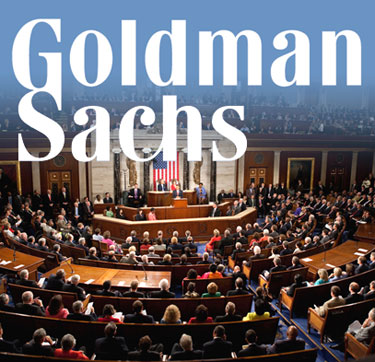
 goldmancon.jpg
  
 Goldman and the bankers let Congress know who is in charge.
  
“Lobbyists for Big Finance are working hardest to neutralize the so-called Volcker Rule, which would force big banks to spin off their lucrative proprietary trading operations, in which they invest their own capital in speculative deals,” Kevin G. Hall writes for McClatchy Newspapers.
The measure is named after former Fed mob boss Paul Volcker. It prevents the banksters from betting against trades they made on behalf of their customers, a popular practice until the fuse was lit on the global economy beginning in 2008. Goldman Sachs sold customers overvalued mortgage bonds and then turned around and made secret bets those bonds would default.
Lobbyists are crawling all over the district of criminals like blood thirsty ticks on a swamp dog. They are working to “soften” requirements that Wall Street firms put more “skin in the game” by retaining more mortgage bonds on their books to guard against shoddy lending. They’re also trying to undercut the new Consumer Financial Protection Bureau, according to McClatchy.
Bailout watcher Elizabeth Warren said the Financial Protection Bureau is the strongest financial reform in Obama’s bill. However, considering the bureau’s proposed makeup, it is destined to rolled in like a Trojan horse. “The bureau will consolidate employees and responsibilities from a host of other regulatory bodies, including the Federal Reserve, the Federal Trade Commission, the Federal Deposit Insurance Corporation and even the Department of Housing and Urban Development,” the New York Times reported in September.
The Federal Reserve was established by private bankers — banks and associated businesses owned by the Rockfellers, J.P. Morgan, the Rothschilds, Lazard Freres, Schoellkopf, Kuhn-Loeb, the Warburgs, Lehman Brothers and Goldman Sachs — and exists solely to manipulate and control the nation’s money supply.
Goldman Sachs was a top Obama contributor along with Citigroup, JP Morgan Chase and Morgan Stanley. “Goldman’s connections to the White House and the Obama administration are raising eyebrows at a time when Washington and Wall Street are dueling over how to overhaul regulation of the financial world,” McClatchy reported in April. “Several former Goldman executives hold senior positions in the Obama administration, including Gary Gensler, the chairman of the Commodity Futures Trading Commission; Mark Patterson, a former Goldman lobbyist who is chief of staff to Treasury Secretary Timothy Geithner; and Robert Hormats, the undersecretary of state for economic, energy and agricultural affairs.”
From the very start, the Barry Obama administration was stacked like a crooked card deck withbankster insiders. Out of 14 top cabinet selections, 9 are affiliated with the Bilderberg group, 10 with the Council on Foreign Relations and 5 of are affiliated with the Trilateral Commission.
Now that the mid-term election is safely behind us, the elite plan to dump aspects of the so-called financial reform bill — like protecting consumers from loan sharks and shady investment hucksters — and continue their plan to slow motion implode the economy and take blindsided tax payers to the proverbial cleaners.


Fresh food that lasts from eFoods Direct (Ad)

Live Superfoods It is time to Wake Up! You too, can join the "Global Political Awakening"!

Print this page

PureWaterFreedom

Wednesday, October 20, 2010

Time Magazine: Prospect Of Civil War In U.S. “Doesn’t Seem That Far Fetched”

Paul Joseph Watson
Infowars.com
October 20, 2010
Time Magazine: Prospect Of Civil War In U.S. Doesnt Seem That Far Fetched 201010top
With protesters in France entering a seventh day of strikes and demonstrations against draconian austerity measures, many political observers in the U.S. are now wondering how long it will be before similar scenes unfold on American streets, with even Time Magazine now conceding that the prospect of a civil war in the States is “not that far fetched”.
To be clear, Stephen Gandel’s article entitled Will the Federal Reserve Cause a Civil War?largely dismisses the possibility that the Fed’s upcoming November 3rd meeting, during which Ben Bernanke is expected to announce a fresh round of money printing, will prompt national uproar, but it doesn’t exactly debunk the notion of longer term social dislocation as a backlash to the crumbling economy, as many are now forecasting.
As we highlighted yesterday in a piece that was later picked up by the Drudge Report, it’s only a matter of time before Americans are hit with almost identical austerity measures to those that have caused the French to set up fuel blockades, stage running battles with riot police, halt air and rail travel, and virtually shut down some areas of the country.
The question remains – how will Americans react if the Obama administration pushes ahead with its plan to seize all private 401(k) pensions, which will be swallowed up by the Social Security Administration under the banner of mandatory Guaranteed Retirement Accounts? How will Americans react to the upcoming announcement that the Federal Reserve will further eviscerate the value of the dollar by purchasing junk assets from big banks at exorbitant prices with money printed out of thin air?
Time Magazine, which as a guardian of the establishment would normally be expected to disparage the potential of mass civil disobedience, actually lends the notion some spotlight bylinking to a Zero Hedge story which paraphrased economic forecaster David Rosenberg, who warns that the Fed’s plan for more quantitative easing, “positions US society one step closer to civil war if not worse.”
The article also features a quote from a Washington’s Blog piece which warns that the Fed’s policies could lead to the very destruction of the republic.
“In a very real sense, Bernanke is throwing Granny and Grandpa down the stairs – on purpose. He is literally threatening those at the lower end of the economic strata, along with all who are retired, with starvation and death, and in a just nation where the rule of law controlled instead of being abused by the kleptocrats he would be facing charges of Seditious Conspiracy, as his policies will inevitably lead to the destruction of our republic.”
Lending the notion credence, Gandel writes, “With the Tea Party gaining followers, the idea of civil war over economic issues doesn’t seem that far-fetched these days.”
Yes, you read that correctly. EvenTime Magazine is now conceding that the current economic course of the nation could lead to outright civil war and revolution.
Gandel finishes the article by leaving the prospect of widespread civil unrest as an open question.
“So it seems clear what the Fed is likely to do,” he writes. “How the economy, the militias and the rest of us react is up in the air. The count down is on. T minus 15 days to Fedamageddon. See you there, hopefully.”
Of course, people like Gerald Celente and a host of other economic forecasters have been predicting civil unrest, food riots and tax rebellions for the past two years, but to have Time Magazine seriously entertain the notion of civil war in the United States is a shocking reminder of just how close to the precipice we now stand.
How Americans will react to what many see as a make or break moment for the US economy, the Fed’s announcement on November 3rd, largely depends on how well they understand the fact that their financial future and that of their children now hangs in the balance like never before.
As the Economic Collapse Blog points out, QE2 represents the biggest bank robbery in history, and is nothing less than another huge transfer of wealth from American taxpayers to big banks. The money Bernanke prints out of thin air, which will further devalue the greenback and every dollar earned or saved by American citizens, will be used to purchase large quantities of “troubled assets” from U.S. banks at well above market price. Small banks will be allowed to wither and die, whereas the huge megaliths will collect mountains of free money at the expense of hard working Americans.
The long term impact of the Fed buying these toxic junk assets with money printed out of thin air will be an inflationary holocaust that does nothing to rescue the US economy but everything to depreciate the very real assets of the American taxpayer.
We are already on the road to serious inflation and the Federal Reserve has not even fired up the money hoses yet. So what is going to happen after they pump trillions more into the economy?
Printing more money and giving it to the banks is not going to solve our economic problems. It is just going to make them worse.
But unfortunately, American voters get no say about any of this. Our national monetary policy is in the hands of an unelected central bank that does pretty much whatever it wants.
If as many Americans were aware of what the Federal Reserve is about to do with their financial future as are knowledgeable about the intricacies of Dancing with the Stars, then the “civil war” that even Time Magazine is now presenting as a justifiable response to the crisis would be a very plausible prospect.
As it stands, according to the majority of voters in our poll on Prison Planet.com, Americans will react to the situation not by organizing fuel blockades, marching in the streets and shutting down the country, but by scratching their butts and flipping the TV channel.
Watch Matt Taibbi’s explanation of what the Fed is about to do with your money. 


Related Articles:

Why is the White House Against Freezing Foreclosures in the Face of Rampant Fraud?

Darwin’s Law of Maladaptive Corporate Behavior (or, why bailouts are nearly always a terrible idea)


Fresh food that lasts from eFoods Direct (Ad) 


Live Superfoods It is time to Wake Up! You too, can join the "Global Political Awakening"!

Print this page

Are you ready to evacuate?

Darwin’s Law of Maladaptive Corporate Behavior (or, why bailouts are nearly always a terrible idea)

By Barry Ritholtz
The Big Picture

What is more important than survival?

On planet Earth, nothing. The most basic rule of life is SURVIVE. The Biological imperative of living things is to perpetuate their existence — survive, procreate, further the species. It is hardwired in the DNA of every living organism.

Those that do not succeed in satisfying these imperatives are described as maladaptive — not fit to survive or compete in the natural world. It is the most rudimentary law in biology, applicable from single cell protozoa to human beings.

And, it exists in the world of organizations. Entities that are maladaptive — corporations, nonprofits, governments — eventually succumb to their own mortality and collapse. This is as it should be, as there are no reasons dysfunctional corporations unable to perform their most basic function — survival — should be preserved.

This is especially true when it comes to financial firms — banks, insurers, investment houses — whose prime responsibility is identifying potential reward and managing risk. The failure of survival raises a compelling question: Why should firms that fail their most basic charge — survival — be bailed out? If on their own they are too incompetent to merely continue to exist, what other manner of disasters live within their balance sheets, legal obligations, managerial skill sets?

A firm that is so reckless and irresponsible as to have put its own survival at risk is not only maladaptive — it has failed its most basic duty. If a company’s management demonstrates an inability to perform that most basic of functions, we should not assume they managed to do anything else competently. Indeed, our assumption should be that they likely are unable to perform their other duties competently, and plan accordingly. Our working presumption should be that maladaptive corporations are not very competent at anything.

The events of the past year have demonstrated this to be all too factually correct. The firms that were unable to survive on their own without a government bailout — AIG, Bank of America, Bear Stearns, CitiGroup, etc. — were rife with incompetence. That is precisely what we have learned since the bailouts.

If I informed you that a corporate entity was so reckless and incompetent that they were unable to insure their own survival, would you bet the rest of their behaviors were responsible or reckless? Competent or incompetent? If they put their very survival at risk, why wouldn’t the rest of their behavior on issues that mattered less be performed at a higher standard?

As we have learned, they weren’t. The same managerial incompetency, shorttermism, inappropriate compensations schemes that led to these firms’ downfall was woven throughout their entire companies. From corporate culture to leadership to staffing to organizational procedures, failed companies turn out to fail in many, many other ways.

Below is a short list of colossal failures. Some of these maladaptive corporate behaviors led to their demise; others were inadequacies that were just below the surface, waiting to wreak more havoc following their bailouts. Consider these, and ask yourself if they were discharged in any more competent fashion than the behaviors that led to these firms insolvencies:
• Not just bad, but terrible loans: Banks created an assembly line to make substantial numbers of loans to unqualified borrowers. Not a tiny fraction of the trillions in mortgages written, but a number that was 10-20X historical averages. This was systemic failure at the most basic level.
• Haphazard Securitization: The process of assembling mortgages in RMBS and CDOs was done in a slipshod fashion as to now be under signficant challenge from major firms such as Blackrock, PIMCO, and even the NY Fed. Buyers of these products are now exercising their legal rights to put them back to the firms that fabricated them. The technical procedural warranties of the structured product are one basis of challenges; so to are the substance of what was sold. Not getting form or substance correct is (to say the least) maladaptive.
• False Affidavits, Perjury, Fraud: As the Fraudclosure debacle has unfolded, we have learned that bailed out firms have no respect for the Rule of Law or for fundamental Property Rights. This is as expected, for in managing to get bailed out, they learned that the most fundamental rule of all — the Darwin’s Law of the Survival — does not apply to them. Exempt from that, why would trivialities such as due process or property rights matter if that didn’t?
• Hiring Grossly Incompetent or Criminal Third Parties: Same as above. Why should they hire law firms to prosecute foreclosures properly — Hey, that’s expensive! — when they can hire criminal foreclosure mills to do at 10 cents on the dollar. Hire qualified people and train them properly? Not when we can get burger flippers on the cheap! And if a few of the wrong people lose their homes, we will write them checks — its the Ford Pinto approach to foreclosures!
• MERS: Fabricating a Shadow Legal System: Even worse then above, an entire group of (subsequently bailed out) banks got together to conspire to circumvent legal protections. To quote U.S. Representative Alan Grayson of Florida “MERS is the central device by which the banks have tried to opt out of the legal system and the real-property record system. They have taken it upon themselves, with the supposed consent of the borrowers, to violate a system of property record-keeping that we’ve had going back centuries.” If you are surprised by this, you have not been paying attention.
• God-Awful Acquisitions: In making significant acquisitions, management eschewed full due diligence in order to grab an asset quickly. Some people have defended BofA’s Merrill purchase as patriotic, but how do you explain the Countrywide buy? (If Exxon bought Enron, would we have bailed them out after Enron collapsed also?)

We could continue with this exercise, but the point is clear: When you save a failed institution, when you bail out a bank whose own behavior led to its demise, you are also saving a parade of horribles within that firm. The passage of time merely reveals the rest of the incompetency of these firms that is below the surface.

What is the next bailed out corporate failure to be revealed . . . ?

Read More

Related Articles:

Welcome to the Machine: MERS and The Shadow Banking System


Fresh food that lasts from eFoods Direct (Ad)

Live Superfoods It is time to Wake Up! You too, can join the "Global Political Awakening"!

Print this page

Are you ready to evacuate?
Jasper Roberts Consulting - Widget